E-mail: sale@xxdahan.com
Follow Us 


Heavy-duty belt conveyors serve as the core lifeline of modern aggregate processing plants, ensuring a continuous, high-tonnage material flow from the quarry face to final stockpiles. For plant operators and engineers, maintaining a seamless material flow directly defines overall profitability. Upgrading to engineered heavy-duty conveyor solutions is essential to withstand severe impact loads, prevent unexpected downtime, and keep high-capacity production lines running.
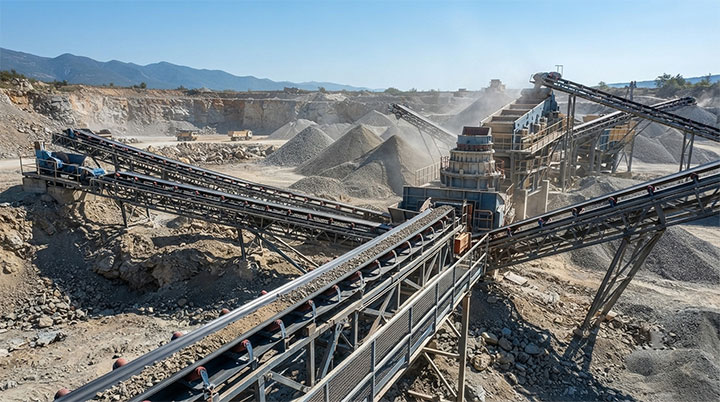
Running an aggregate plant means subjecting equipment to continuous, punishing workloads. Analyzing why standard conveyor setups fail under these conditions helps plant operators prevent unexpected downtime and costly maintenance bottlenecks.
Standard conveyor belts often break down near primary crushers and transfer chutes. The sheer weight and sharp edges of unwashed stone falling from high drops generate severe impact stress. Without reinforced protection, standard belts suffer from rapid carcass punctures, cover gouging, and edge fraying, resulting in constant repair delays.
Heavy-duty belt conveyors solve these failures through advanced structural design. Utilizing high-performance EP (Polyester-Nylon) or NN (Nylon-Nylon) multi-ply carcass specifications, alongside high-tensile Steel Cord (ST500 to ST2500+) constructions, these systems absorb high-tonnage impacts. Combined with superior DIN X, Y, or W abrasion-resistant rubber covers (featuring tensile strengths ≥ 20 MPa and a rubber hardness of 60±5 Shore A), they resist continuous friction and deliver exceptional tensile strength for long-distance transport.
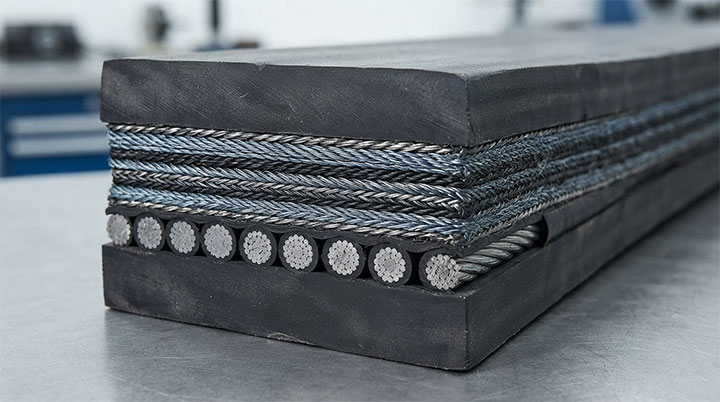
Implementing heavy-duty conveyor systems requires matching the right belt specifications to each specific phase of the production circuit.
At the primary crushing stage, conveyors handle unconditioned, oversized rock straight from the quarry. Heavy-duty rubber conveyor belts reinforced with EP300/4 to EP500/5 multi-ply carcass layers and thick rubber top covers (such as 6mm to 8mm thickness) are deployed here to absorb massive shock loads and resist tearing caused by jagged stone impacts.
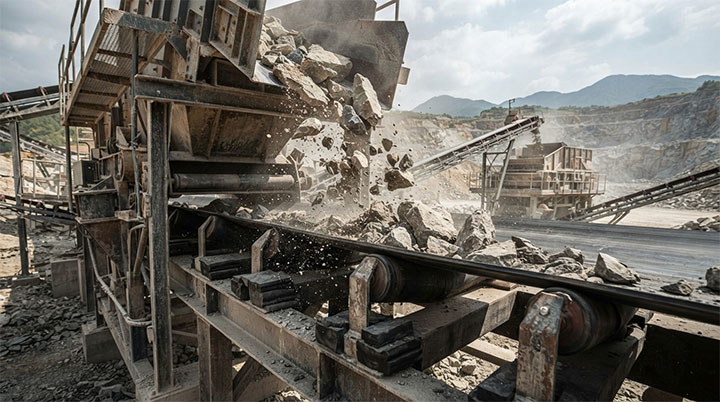
Moving through screening and washing plants, conveyors must contend with moisture, slurry, and abrasive fine sand. Specially treated water-resistant and oil-resistant rubber compounds prevent belt slippage and degradation, ensuring smooth material transfer between wet decks and stockpiles while maintaining stable operational friction coefficients.
Finished aggregates are transported over longer distances to radial stackers or storage yards. High tensile strength steel-cord belts (such as ST1000 or ST1250) provide the necessary low elongation resistance (under 0.2%) and high load capacity to move high tonnages across extended spans efficiently.
Choosing the optimal belt construction is critical for operational efficiency. Use the following guide to match your aggregate processing requirements with the right belt design:
| Feature | Fabric Belt (EP/NN) | Steel Cord Belt (ST Series) |
|---|---|---|
| Primary Application | Medium-distance, moderate loads | Long-distance, high-tonnage overland |
| Tensile Strength | Moderate (Multi-ply structure) | Extremely High (ST500 to ST2500+) |
| Elongation | Higher (1.5% - 3.0%) | Very Low (< 0.2%) |
| Impact Resistance | Good (Absorbs shock via plies) | Excellent (High-tensile steel cord) |
| Ideal Use Case | Feeders & In-plant transfer | Main trunk lines & Storage yards |
Maximizing the return on investment for heavy-duty conveyors requires proactive maintenance. Implement these four key strategies to eliminate unexpected downtime and extend operational lifespan:
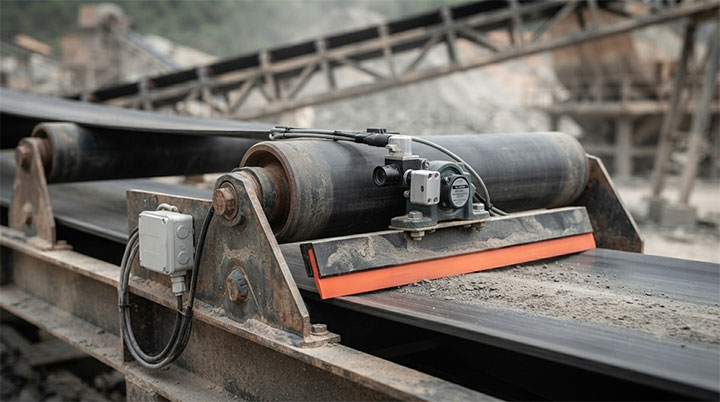
Install primary and secondary polyurethane belt scrapers to eliminate material carryback, preventing roller buildup and premature belt wear on return runs.
Replace traditional idlers with energy-absorbing rubber impact bars at high-drop transfer points to cushion heavy rock loads and prevent carcass punctures.
Integrate thermal sensors and vibration monitors to detect minor component anomalies early, shifting from reactive repairs to predictive maintenance.
Maintain correct belt tension (recommended 0.5% to 1.5% elongation) and use self-aligning idlers to prevent edge-fraying and uneven tracking.
Multi-ply EP (Polyester-Nylon) and NN (Nylon-Nylon) fabric belts are highly flexible and cost-effective for medium-length transport and moderate impact zones. Steel cord belts (such as ST series) provide superior tensile strength, minimal elongation under heavy loads, and high impact resistance, making them ideal for long-distance, high-tonnage overland conveyors.
Spillage can be effectively minimized by matching the belt trough angle (typically 20° to 35°) to the load, installing adjustable skirting systems with polyurethane wear liners, and utilizing impact beds to stabilize the material flow right where it drops from crushers.
The primary causes include severe impact shock from large unwashed stones, material carryback trapped between return rollers, improper belt tensioning causing edge friction, and selecting inadequate rubber cover specifications (such as failing to use DIN X or W high-abrasion grades).
Stop losing revenue to unexpected downtime and inefficient material handling. Connect with our engineering team today to get a customized heavy-duty conveyor solution and a fast technical quote tailored to your processing plant.
CONTACT
WhatsApp:+86 18339211009
Email:sale@xxdahan.com
Add:China, Henan Province, Xinxiang City.Yanjin county forest park gate to the west 1000 meters north road