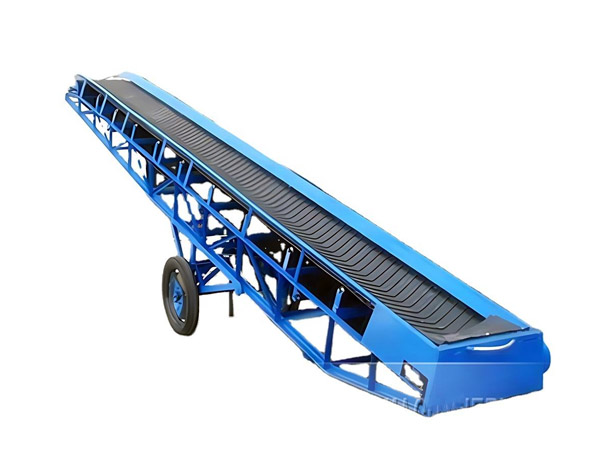
Aggregate Rubber Conveyor Belt
Aggregate Rubber Conveyor Belts are used for conveying sharp, abrasive, and heavy aggregates such as crushed stone, sand, and gravel. The thickened rubber provides strong wear resistance and cut resistance, and lengths can reach 200 meters.
Belt width: 400 mm ~ 1600 mm
Carrier material: EP100 ~ EP630 / NN100 ~ NN400 / ST630 ~ ST3500
Cover rubber thickness (top/bottom): Top: 6~12 mm / Bottom: 3~6 mm
Belt speed: 0.8 ~ 3.15 m/s
What is an Aggregate Rubber Conveyor Belt?
Aggregates are fundamental materials in construction, road, and bridge engineering, mainly composed of crushed stone, pebbles, sand, slag, and recycled concrete particles. Aggregates are characterized by high hardness, sharp edges, high density, and strong abrasion resistance. During transportation, PVC or lightweight conveyor belts will be cut or worn to the core within a few months. An Aggregate Rubber Conveyor Belt, however, uses high-strength canvas or steel wire rope as a skeleton and highly abrasion-resistant and cut-resistant rubber as a covering layer. It is wear-resistant, tear-resistant, and impact-resistant, and can operate stably for a long time under conditions of high drop, high speed, and high load. It can effectively complete the transportation, transfer, and loading of aggregates. Conveying lengths range from 1-200 meters, with a conveying capacity of up to 800 m³ per hour. Belt width specifications include 400mm, 500mm, 600mm, 800mm, 1000mm, 1200mm, and 1400mm.
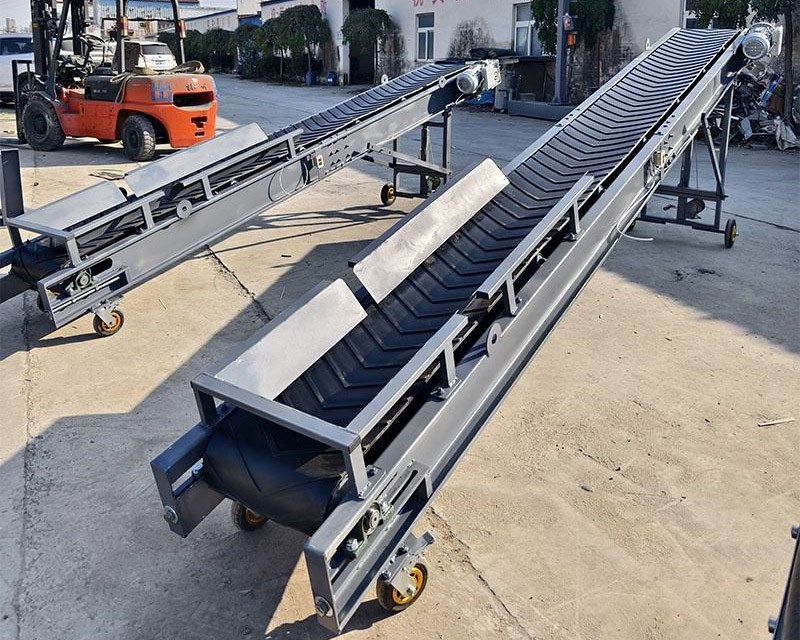
What are the applications of Aggregate Rubber Conveyor Belts?
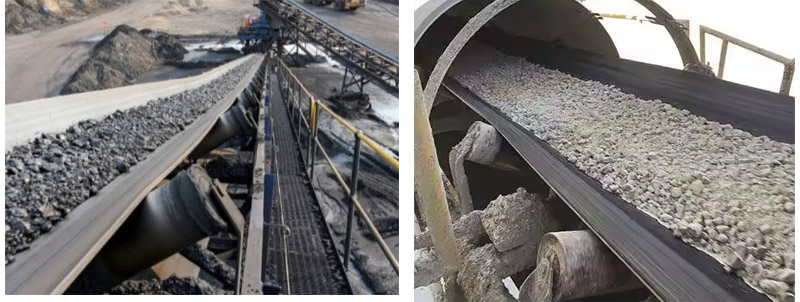
Aggregate Rubber Conveyor Belt is used for transporting aggregates from one location to another in aggregate production, commonly found in quarries, sand and gravel plants, and concrete mixing plants.
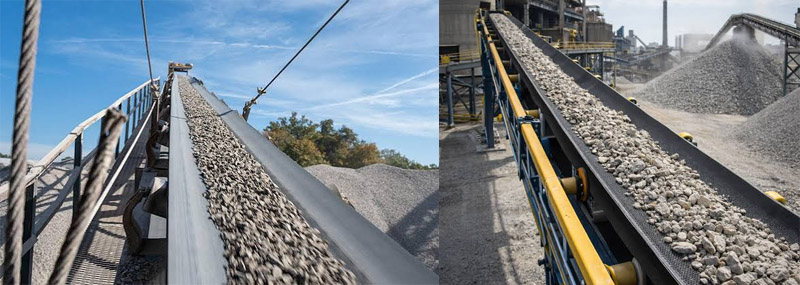
Quarries and Mines: Transporting crushed stone and boulders from blasting or mechanical extraction from the mining site to the crusher, or transferring them between different crushing stages.
Sand and Gravel Processing Plants: Conveying screened aggregates of different particle sizes (5-10mm, 10-20mm, 20-31.5mm, etc.) to silos or stockpiles, as well as for return material transport.
Concrete Mixing Plants: Transporting sand and gravel stored in silos or stockpiles to the mixing unit according to the specified proportions; a key piece of equipment for achieving automated batching.
Asphalt Mixing Plants: Transporting dried and heated aggregates; in this case, the conveyor belt needs to possess both heat resistance (120~180℃) and wear resistance.
Ports and docks: Used for loading and unloading aggregates onto ships and transferring them between storage yards, requiring conveyor belts capable of withstanding long-term continuous operation.
Recycled aggregate production lines: Transport recycled aggregates from crushed construction waste. These materials often contain sharp foreign objects such as rebar ends and broken glass, demanding higher puncture resistance from the conveyor belts.
What are the advantages of an Aggregate Rubber Conveyor Belt?
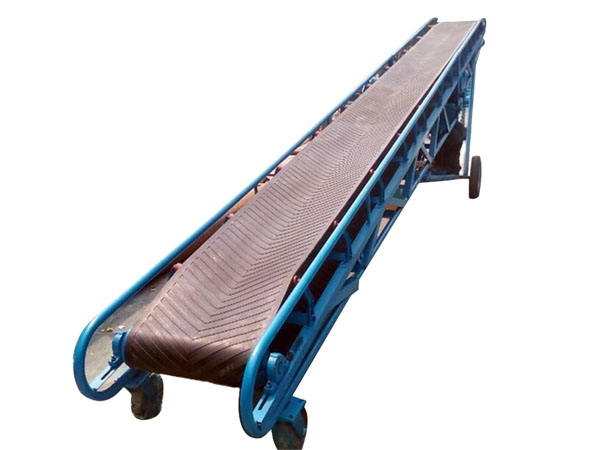
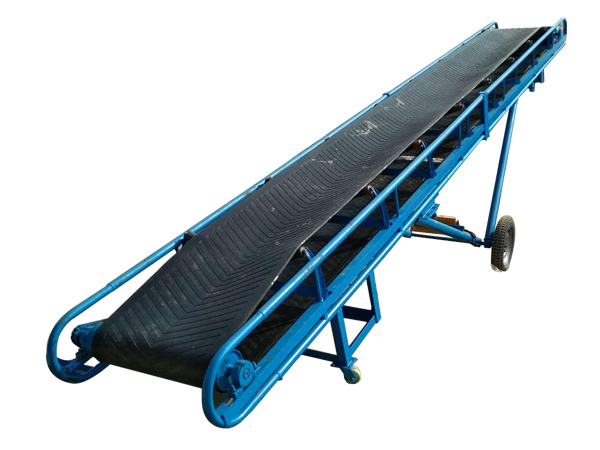
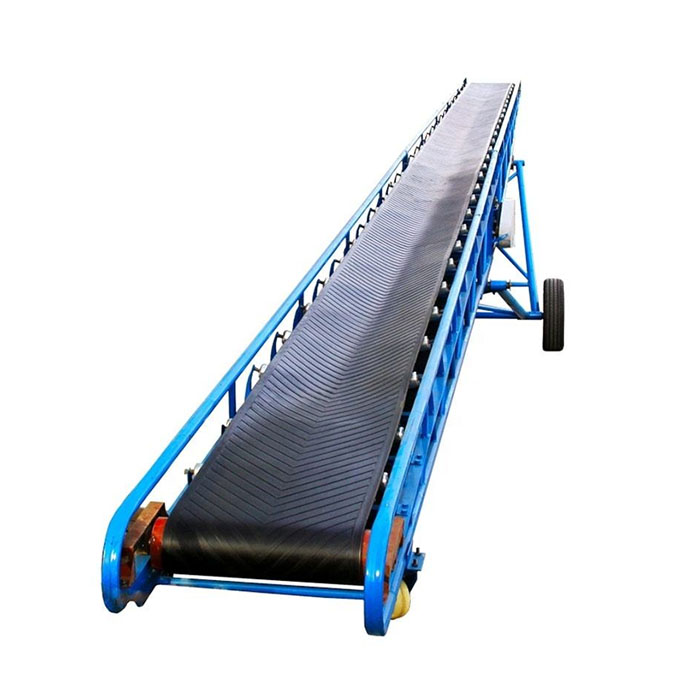
Because aggregates are abrasive and impact-resistant, the cover rubber of the Aggregate Rubber Conveyor Belt is made of natural/styrene-butadiene rubber reinforced with high abrasion-resistant carbon black. According to DIN 22102 standards, the abrasion loss is ≤ 150 mm³ for DIN Y grade and ≤ 90 mm³ for DIN W grade, which is 3-5 times the life of ordinary belts. The high elasticity and toughness of the rubber layer can absorb the point impact of sharp aggregates and is not easily "chiseled through" or torn into long cracks. Rubber's flexible texture, combined with multi-layered polyester (EP) canvas or steel cord core, allows for perfect fit with trough-shaped idlers at 30°, 35°, and even 45° angles, preventing aggregate spillage and increasing conveying capacity. Rubber conveyor belts are naturally ozone and UV resistant, maintaining elasticity even in outdoor environments ranging from -30°C to +70°C. In contrast, PVC belts harden at low temperatures and soften at high temperatures, significantly reducing their lifespan. Furthermore, for conveying aggregates at angles greater than 18°, herringbone patterns, deep groove patterns, or corrugated sidewalls and partitions can be selected to prevent aggregate slippage and spillage. Customized conveyor belt types and lengths are also available upon request.
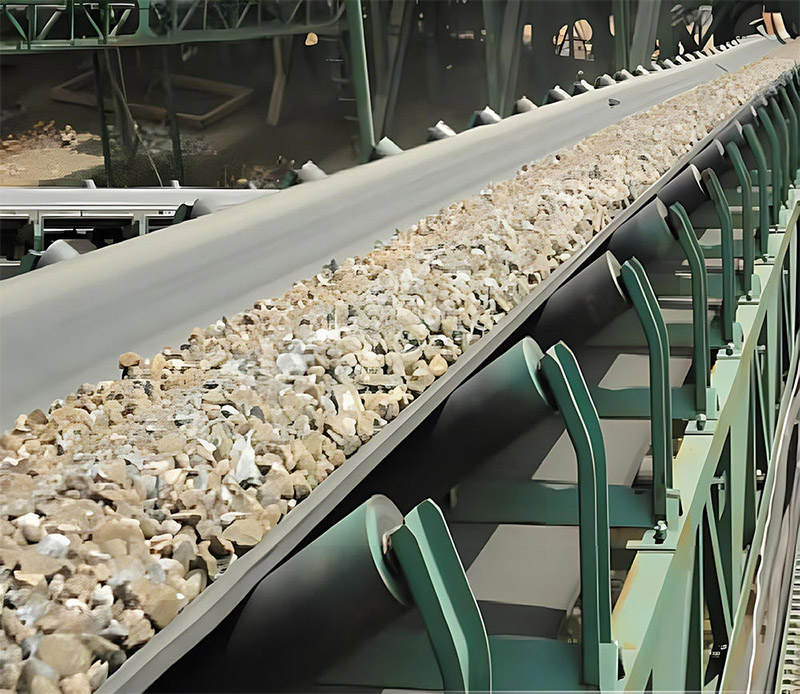
How does an Aggregate Rubber Conveyor Belt work?
During aggregate conveying, the drive roller propels the conveyor belt through friction. Aggregate falls from the inlet into the middle of the belt, where the belt, supported by the idler group, forms a trough shape, keeping the aggregate stably centered. The conveyor belt forms a closed loop by wrapping around the tail-end redirecting roller, enabling continuous cyclic conveying. Simultaneously, buffer idler groups or buffer beds can be installed below the material drop point. Based on the conveyor belt's own thick buffer rubber layer (≥3mm), the impact force of large aggregate pieces is dispersed over a larger area, preventing the skeleton layer from breaking. Anti-overflow skirts are installed on both sides of the conveyor belt to reduce the spillage of fine aggregate from the edges.
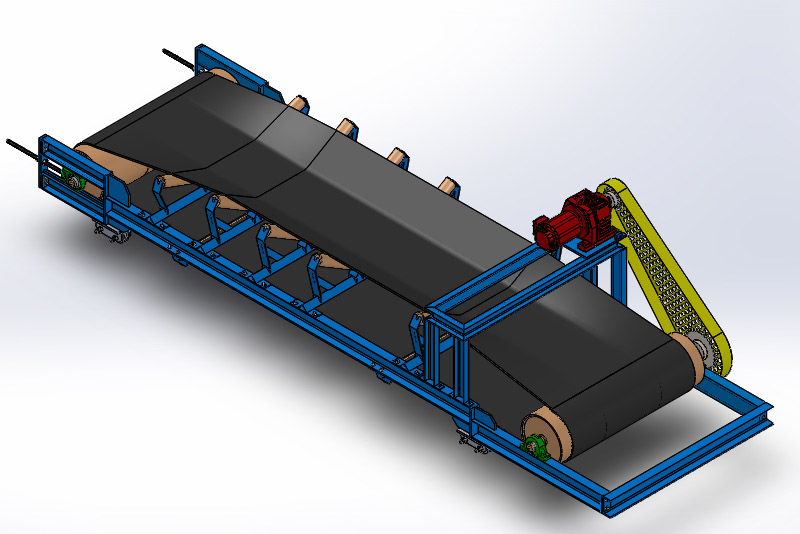
Aggregate Rubber Conveyor Belt Parameters
|
Tape Width (mm) |
Conveying Length (m) Power (kW) |
Conveying Speed (m/s) |
Conveying Capacity (t/h) |
||
| 400 |
≤10 3 |
12-15 3-4 |
15-30 4-7.5 |
1.25-2.0 | 30-60 |
| 500 |
≤10 3 |
12-15 4-5.5 |
15-30 5.5-7.5 |
1.25-2.0 | 40-80 |
| 650 |
≤10 4 |
12-15 7.5 |
15-30 7.5-11 |
1.25-2.0 | 80-120 |
| 800 |
≤10 4 |
12-15 7.5 |
15-30 7.5-15 |
1.25-2.0 | 120-200 |
| 1000 |
≤10 5.5 |
10-20 7.5-11 |
20-40 11-22 |
1.25-2.0 | 200-320 |
| 1200 |
≤10 7.5 |
10-20 7.5-15 |
20-40 15-30 |
1.25-2.0 | 290-480 |
| 1400 |
≤10 11 |
10-20 15-22 |
20-40 22-45 |
1.25-2.0 | 400-680 |
| 1600 |
≤10 15 |
10-20 22-30 |
20-50 30-75 |
1.25-2.0 | 600-1080 |
| 1800 |
≤10 18.5 |
10-20 30-45 |
20-50 45-110 |
1.0-2.0 | 800-1500 |
| 2000 |
≤10 22 |
10-20 45-55 |
20-50 55-132 |
1.0-2.0 | 1000-2000 |
| 2400 |
≤10 30 |
10-20 55-75 |
20-50 75-185 |
1.0-2.0 | 1500-3000 |
Aggregate Rubber Conveyor Belt Types and Composition
The Aggregate Rubber Conveyor Belt can flexibly match aggregate conveying needs from short-distance light loads to long-distance heavy loads, and from ordinary abrasion to extreme working conditions, by selecting different belt cores such as EP/NN canvas, steel cord core, and cotton canvas, and Y/W grade wear-resistant, oil, acid and alkali resistant, and cold and heat resistant cover rubber types.
| Classification | Type | Structural Composition / Main Characteristics |
| By Core Structure | Multi-layer Polyester/Nylon (EP/NN) Canvas Belt | With polyester or nylon fabric as the skeleton layer, multi-layer structure, high strength, good elasticity, excellent troughing properties, suitable for medium and long distance aggregate conveying. |
| Steel Wire Rope Conveyor Belt | Using steel wire rope as the skeleton and covered rubber filling, it has extremely high tensile strength and extremely low elongation, suitable for long-distance, high-capacity aggregate trunk lines. | |
| Cotton Canvas Belt | Using cotton canvas as the skeleton, it has fewer layers and a lower price, suitable for short-distance aggregate conveying with dry conditions and low loads. | |
| By Cover Rubber Performance | DIN Y Grade (High Abrasion Resistance) | The cover rubber has high abrasion resistance and is used for general abrasive aggregates (such as limestone and crushed gravel). |
| DIN W Grade (Extremely Abrasion Resistant) | Cover rubber has excellent abrasion resistance and is used for highly abrasive aggregates (such as granite, basalt, and high-hardness sandstone). | |
| Oil-Resistant / Acid and Alkali-Resistant | Cover rubber is formulated with oil-resistant or acid and alkali-resistant materials for handling aggregates containing oil or chemical reagents. | |
| Cold-Resistant / Heat-Resistant | Cover rubber contains special components to adapt to low-temperature or high-temperature environments and is used for cold or high-temperature aggregate conveying conditions. |
Aggregate Rubber Conveyor Belt Case
At a large granite aggregate production line in East China, ordinary rubber belts were initially used. After only three months, the cover rubber was worn through by granite chips, leading to frequent downtime. After switching to Dahan's Aggregate Rubber Conveyor Belt with a 10 mm thick cover rubber, after 14 months of operation, wear remained within a controllable range, average annual downtime decreased by 80%, and conveying costs dropped by nearly 40%.
Aggregate Rubber Conveyor Belt FAQs
Q: What is the difference between an Aggregate Rubber Conveyor Belt and an ordinary rubber conveyor belt?
A: Ordinary rubber belts have a lower wear resistance coefficient in their cover rubber formulation and cannot withstand the sharp edges and continuous wear of aggregates. Aggregate-specific belts have a higher wear resistance and cut resistance rating in their cover rubber, and a thicker, stronger skeleton layer, designed entirely according to aggregate working conditions.
Q: How do I choose the wear resistance grade?
A: This depends on your aggregate type. For moderately abrasive materials such as limestone, DIN Y is recommended; for hard aggregates such as granite and basalt, DIN W is suggested. If unsure, please provide a material sample, and we will assist with testing and recommendations.
Q: Which is more suitable for aggregate conveying: hot vulcanized splicing or mechanical fastening?
A: For long-distance, high-load aggregate conveyors, hot vulcanized splicing is the preferred choice, offering smooth, high-strength joints and reducing impact on idlers. For short distances or emergency repairs, mechanical fastening is more convenient.
Q: How long does an Aggregate Rubber Conveyor Belt last?
A: It depends on the operating conditions. Typically, under moderate abrasion, DIN Y belts can last 1-2 years, while DIN W belts can last 2-4 years or even longer. Proper selection, proper installation, and regular maintenance can greatly extend its lifespan.
Q: Can special specifications be customized?
A: Absolutely. We can customize the cover rubber thickness, number of skeleton layers and rubber type according to your conveyor length, inclination angle, bandwidth and material characteristics, and can even add baffles, skirts and other features.