Inclined Belt Conveyor for Sand
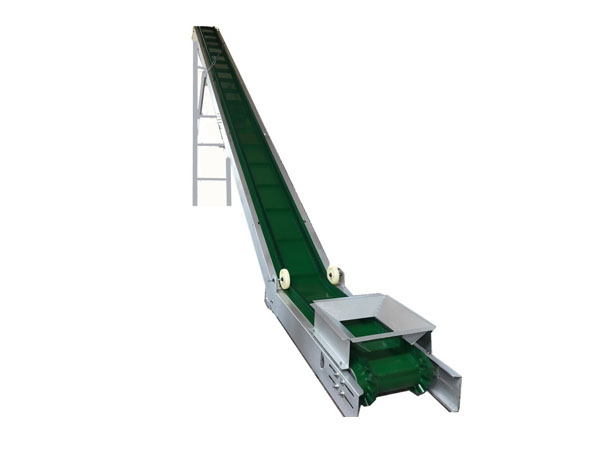
The Inclined Belt Conveyor for Sand is designed to solve problems such as strong sand abrasion, easy spillage, and difficulty in lifting at large angles. It can cleanly transport sand to high places at an angle of up to 90°, and the length and conveying capacity can be customized according to dry and wet sand.
Conveying angle: 20-90 degrees
Conveying capacity: 800 tons/hour
Conveying height: 30 meters
Price: $350-$4900
What is an Inclined Belt Conveyor for Sand?
An Inclined Belt Conveyor for Sand is a bulk material conveyor designed to solve problems such as the high abrasiveness of sand, its tendency to spill, and the difficulty of lifting at large angles. Addressing the complex characteristics of sand, including the high hardness of quartz particles, heavy dust generation from dry sand, and strong adhesion from wet sand, it overcomes the 15-18° inclination angle limitation of ordinary belt conveyors. By employing corrugated sidewall belts capable of vertical lifting up to 90°, or high-wear-resistant rubber belts ensuring stable conveying at steep angles of 25° or higher, combined with sealed guide chutes and anti-overflow skirts, it can operate stably and prevent spillage and dust even under large inclination angles. Single-unit conveying lengths are flexibly selectable from 1-30 meters, and longer distances can be achieved through segmented connection, with conveying capacities ranging from 1 to 800 tons per hour. The system offers flexible configuration options for different sand types: dry river sand uses wear-resistant smooth belts and fully enclosed dust covers; wet sand uses sidewall belts and stainless steel frames; and high-temperature dried sand is equipped with heat-resistant belts and insulation, precisely matching the conveying needs of various applications.
Inlined Belt Conveyor for Sand Parameters
| Parameter Items | Optional Range / Standard Configuration |
| Belt Width | 400mm/500mm / 650mm / 800mm / 1000mm / 1200mm / 1400mm / 1600mm |
| Conveying Length | Customized according to site requirements, single unit up to 30 meters |
| Inclination Angle Range | 0°-28° (Ordinary patterned belt); 30°-90° (Corrugated sidewall belt) |
| Maximum Conveying Capacity | Up to 800 t/h, conveying capacity increases with belt width and speed |
| Belt Type | Abrasion-resistant rubber belt (EP/NN canvas core), PVC belt, sidewall belt (corrugated + crossbars) |
| Frame Material | Carbon steel (standard, painted/hot-dip galvanized), stainless steel (food grade/optional for high humidity environments) |
| Drive Power | According to calculated configuration, adapted to geared motor or electric roller |
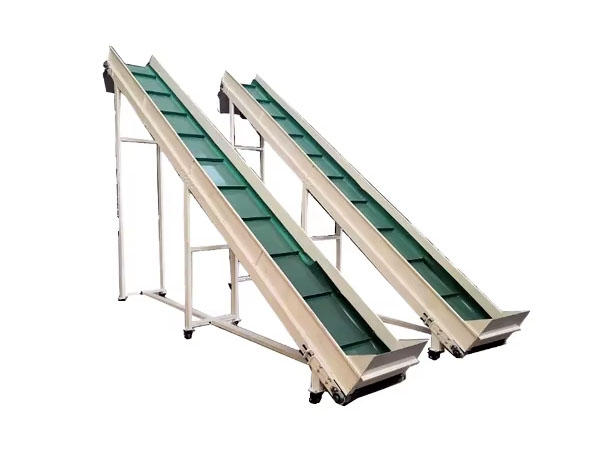
| Optional Structures | Fixed, Mobile (with wheels), Radial Stacking |
What are the advantages of the Inclined Belt Conveyor for Sand?
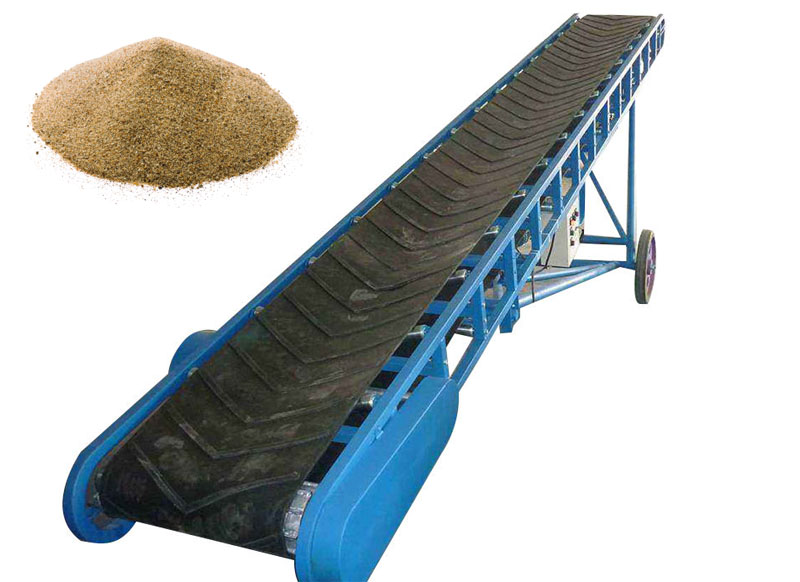
The upper cover rubber of the Inclined Belt Conveyor for Sand uses a highly abrasion-resistant natural rubber formula, with a thickness of 4-6mm or more, and is inlaid with multiple layers of polyester canvas, effectively resisting the cutting and abrasion of sand. For extreme abrasive conditions, belts with special abrasion-resistant coatings can also be selected. When conveying sand at steep angles, herringbone belts can be configured with a maximum inclination angle of 28°, or corrugated sidewall belts with a maximum inclination angle of 90°. In particular, the corrugated sidewall belt inclined conveyor can directly lift sand at steep angles, saving additional space and complex cleaning processes compared to bucket elevators, making it especially suitable for sand pits and mixing plants with limited space.
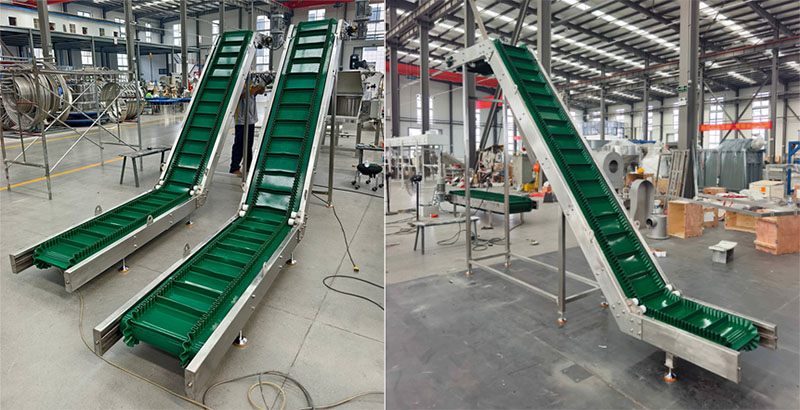
When conveying sand at angles greater than 20°, the flexible corrugated sidewalls on both sides, combined with fixed-spaced crossbars, form a "basin-shaped" bearing surface, effectively preventing sand backflow and side leakage. In terms of dustproof sealing, the entire machine performs exceptionally well: the full-groove idler roller assembly, combined with extended sealing skirts, effectively confines the sand to the center of the belt surface throughout the entire conveying length; the tail receiving point utilizes a guide chute to completely enclose dust generation. For dry sand dust issues, we can provide a fully enclosed dust cover, with pre-installed spray dust suppression or dust collection interfaces at the head funnel and chute. The machine can also be equipped with an optional rainproof canopy, meeting environmental protection requirements while reducing material wind damage.
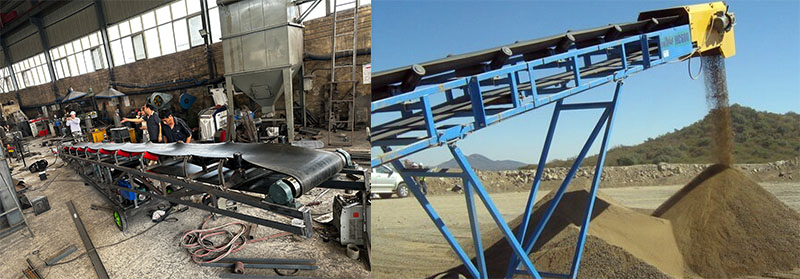
Optional configurations for different working conditions of the Inclined Belt Conveyor for Sand
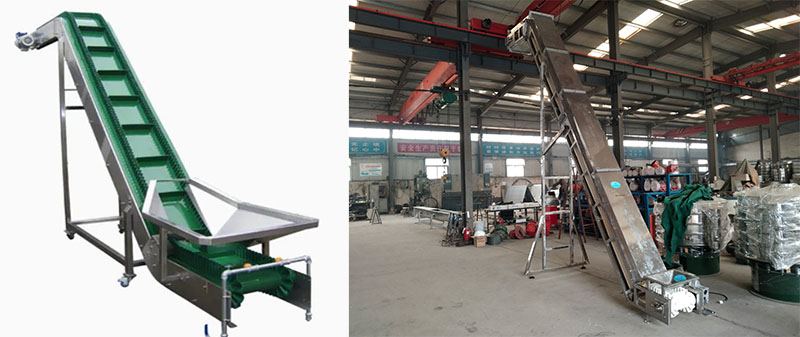
| Working Conditions | Recommended Configuration |
| Dry river sand, manufactured sand, inclination angle <18° | Abrasion-resistant rubber belt + trough idler roller + dust cover |
| Wet sand, high moisture content, requires steep angle lifting | Corrugated sidewall belt + crossbar + stainless steel frame, rust-proof |
| Mobile Sand Yard Stockpile | Mobile Inclined Belt Conveyor with Diesel or Electric Drive Axles |
| High Temperature Drying Sand | Heat-Resistant Rubber Belt, Up to 150℃+ with Insulation Treatment |
How does an Inclined Belt Conveyor for Sand work?
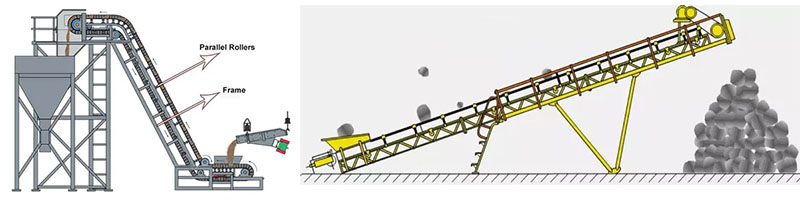
During sand conveying, the rubber belt continuously rotates on a drive pulley at the front and a tension pulley at the rear. Sand is fed into the belt through a guide chute at the rear. To handle sloping surfaces, a herringbone belt or a corrugated sidewall belt with transverse baffles forms a "groove" that firmly grips the sand, preventing it from rolling backward or tipping to the side. As the motor-driven drive pulley rotates, the belt steadily transports the sand up the slope. At the front, the sand is unloaded into a hopper or chute. Throughout the conveying process, full-length sealed skirts and covers effectively prevent dust ingress, while an optional spray system suppresses airborne particles, ensuring a clean operation.
How does an Inclined Belt Conveyor for Sand differ from other conveyors?
Common equipment for conveying sand includes inclined belt conveyors, screw conveyors, and bucket elevators. The advantage of the Inclined Belt Conveyor for Sand is its ability to simultaneously perform horizontal and inclined conveying, a single machine handling all tasks without the need for intermediate transfers.
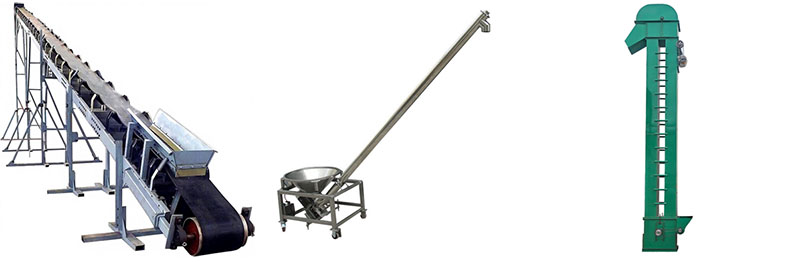
Inclined Belt Conveyor: Can operate continuously horizontally and inclined, with a large conveying capacity, flexible distance, and simple maintenance. When used with sidewall belts, it can achieve steeper lifting angles and has strong resistance to sand abrasion.
Screw Conveyor: While offering good sealing and inclined conveying, its conveying distance is limited, the screw blades are easily worn by sand, and it has high power consumption, making it unsuitable for large-capacity, long-distance transport.
Bucket Elevator: Can only lift vertically and cannot handle horizontal conveying. It is prone to clogging at the bottom, the chain buckets wear quickly, maintenance is complex, and the initial purchase cost is high.
Inclined Belt Conveyor for Sand Case
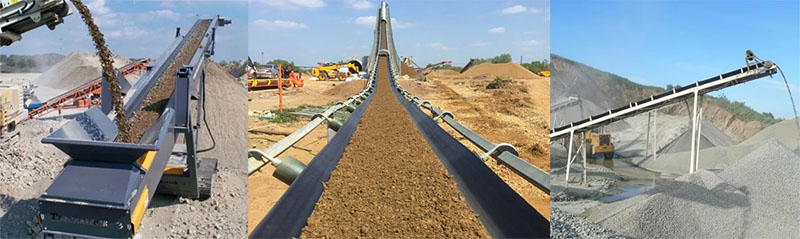
A large manufactured sand plant in Southeast Asia selected a 1000mm wide Inclined Belt Conveyor for Sand from Dahan, equipped with an EP200 wear-resistant belt, corrugated sidewalls, and a fully enclosed dust cover. It is used for conveying manufactured sand with approximately 8% moisture content at a 22° incline, with a belt speed of 1.6m/s, adjustable as needed. The conveying capacity is 350 tons per hour. After two years of continuous operation, no significant belt wear was observed, and the dust concentration on site was far below the standard, requiring almost no routine maintenance.
Inclined Belt Conveyor for Sand FAQ
Q: Can the Inclined Belt Conveyor for Sand convey wet sand?
A: Of course. Wet sand has strong adhesion; we recommend using a sidewall belt and strengthening the cleaning device, while also lining the chutes and hoppers with smooth, wear-resistant plates. If the moisture content is extremely high, a drain section or pre-dewatering can be configured.
Q: What is the maximum angle for tilting sand conveying? A: If using a herringbone belt, a vertical lift of no more than 28° is recommended. A corrugated sidewall belt allows for a 90° vertical lift. Specific limits need to be determined based on the sand's angle of repose and moisture content.
Q: How to prevent dust generation during sand transport?
A: Install sealed covers throughout the entire line and install micro-mist dust suppression systems or connect dust collectors at the material drop points. A well-sealed feed chute can also significantly reduce dust dispersion.
Q: What belt material is best suited for highly abrasive sand?
A: We recommend using high-abrasion-resistant covered rubber belts conforming to DIN 22102 standards, or special abrasion-resistant belts with added ceramic particles. When consulting us, please specify the sand's particle size and abrasiveness to match the optimal model.