E-mail: sale@xxdahan.com
Follow Us 


A long distance belt conveyor (often referred to as an overland conveyor) is a heavy-duty continuous bulk material handling system engineered to transport bulk solids across vast distances—ranging from hundreds of meters to several kilometers—seamlessly, safely, and with minimal energy consumption.
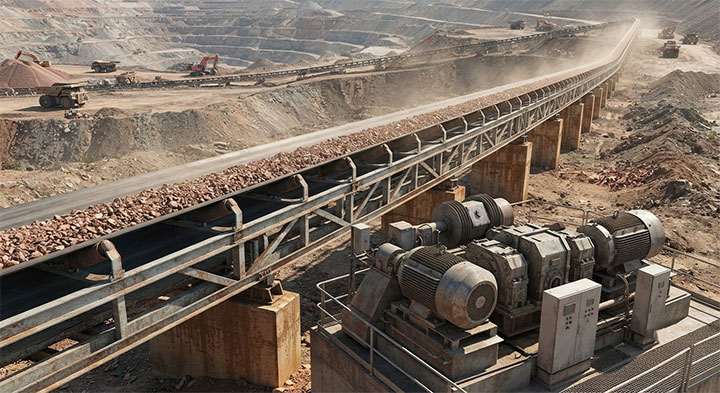
Unlike standard factory conveyors, long-distance systems operate under extreme tensile forces. The core engineering principle relies on distributing drive power across multiple multi-point drive stations to optimize belt tension, reduce stress concentration, and allow the system to safely traverse complex terrains, including slopes and horizontal curves.
A robust overland conveyor system is built upon six critical engineering subsystems:
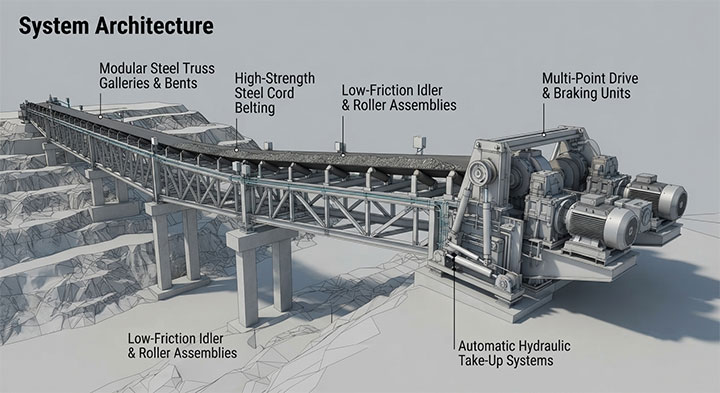
Equipped with high-torque motors and soft-starters or regenerative braking to ensure smooth power distribution and control.
Utilizes heavy-duty steel cord conveyor belts designed for maximum tensile strength, impact resistance, and low elongation.
Precision-engineered idlers strategically placed to minimize rolling resistance, lower friction, and optimize overall energy usage.
Dynamic tensioning units that automatically adjust and maintain consistent belt tension under fluctuating load and temperature conditions.
Real-time sensors tracking belt slip, longitudinal tears, alignment deviations, and bearing temperatures to prevent unplanned downtime.
Modular steel frames and support bents engineered to withstand harsh weather, high winds, and complex uneven topography.
Designed to outperform traditional transport methods in heavy-duty industries, our overland conveying solutions deliver exceptional performance through four core engineering advantages:
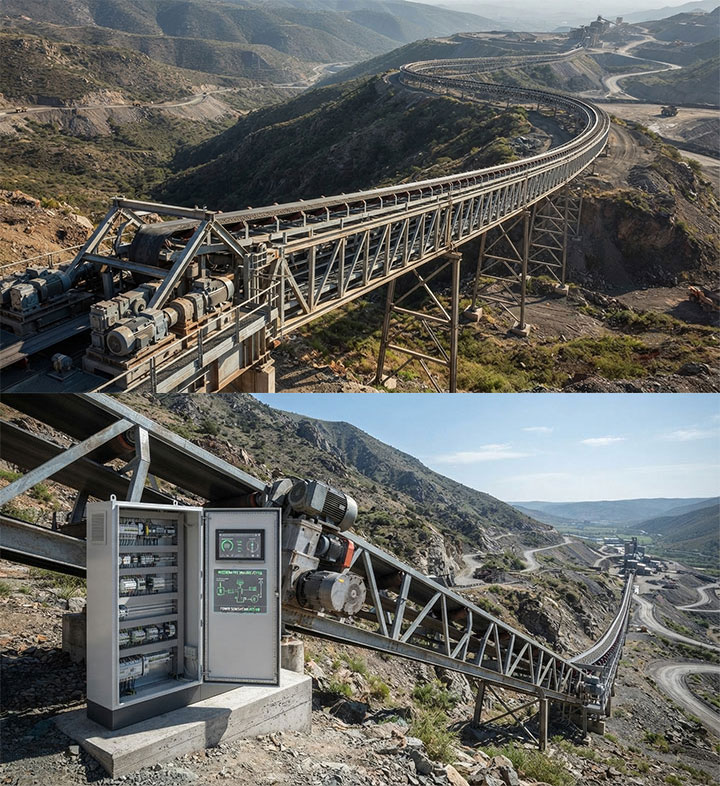
Capable of executing horizontal and vertical curves, seamlessly navigating hills, valleys, and obstacles while eliminating costly intermediate transfer towers.
Optimized friction design and intelligent regenerative braking systems convert gravity potential energy into reusable electrical power on downhill runs.
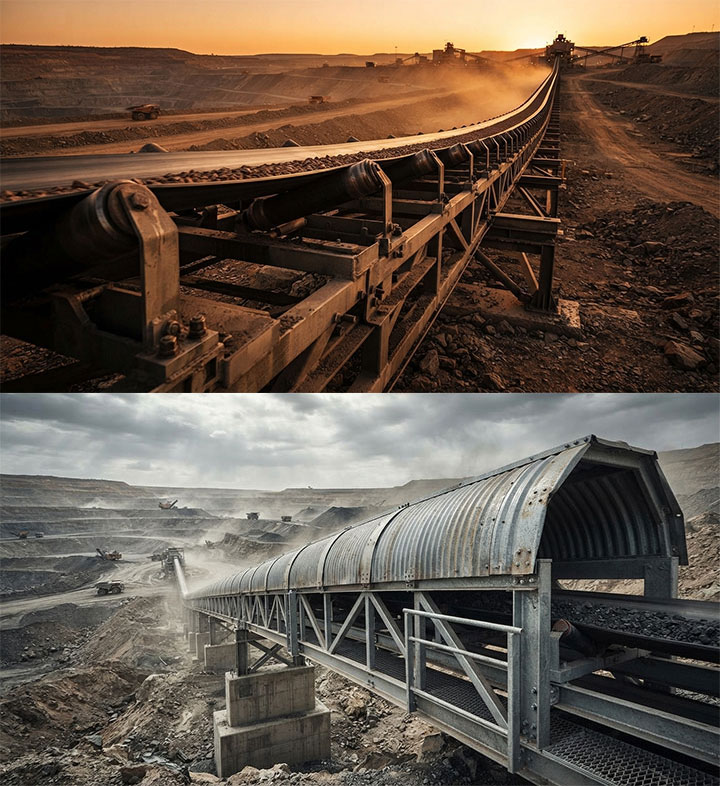
Engineered for 24/7 continuous operation under harsh environmental extremes, significantly reducing unexpected maintenance shutdowns.
Heavy-duty structural components and sealed gallery designs withstand heavy wind loads, extreme temperature fluctuations, and severe abrasive conditions.
Every overland conveyor system is engineered to meet specific project demands. Below are the standard technical specifications and customizable parameters available for industrial bulk handling:
| Parameter Category | Standard Specifications | Customization Options |
|---|---|---|
| Belt Width (mm) | 800mm – 2000mm | Tailored to required throughput (t/h) |
| Conveying Speed (m/s) | 2.5 m/s – 6.0 m/s | Variable frequency drive (VFD) speed control |
| Single Flight Length | Up to 5 km+ per drive section | Multi-drive configuration for extended spans |
| Tensile Strength (St) | St1000 – St4500 | Steel cord grade selected via dynamic tension calculation |
| Drive Power Configuration | Single, dual, or multi-point drive stations | Soft starters, planetary gearboxes, regenerative brakes |
| Max Inclination / Terrain | Up to 16° incline / Horizontal curves supported | Custom route profile engineering based on topography |
Designing a reliable overland conveying system requires meticulous component engineering to manage high belt tensions and dynamic loads. We focus on four critical mechanical aspects:
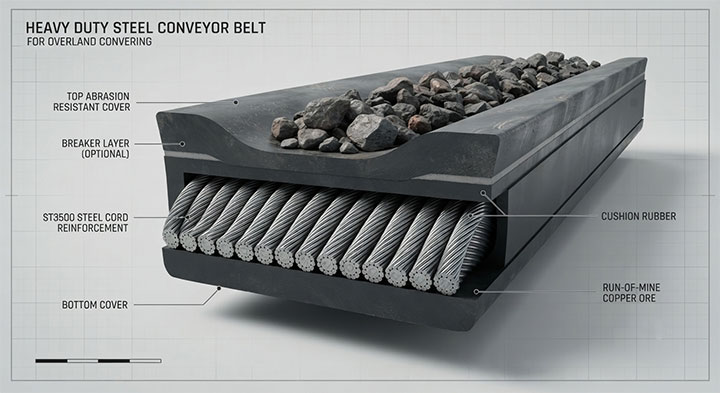
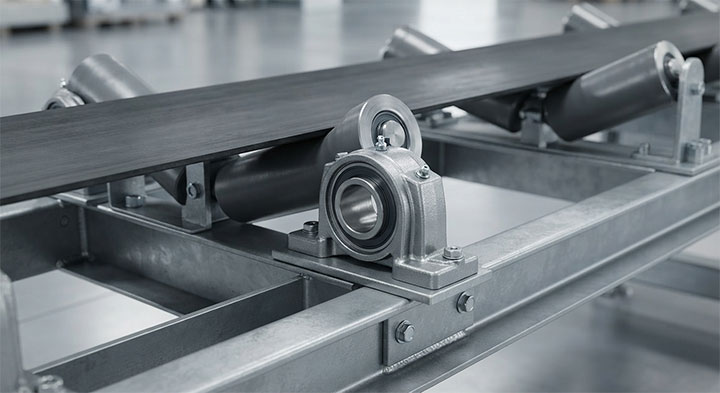
Selecting the correct steel cord grade (St1000 to St4500) ensures maximum tensile strength, minimal elongation under load, and superior impact resistance when handling heavy, abrasive run-of-mine ores.
Distributing power across head, tail, or intermediate drive stations prevents localized stress concentrations on the belt. Regenerative braking controls downhill momentum safely while capturing energy.
Precision-machined rotating components equipped with high-grade sealed bearings significantly cut rotational friction, directly lowering overall system power consumption and operating costs.
Automatic hydraulic or winch-based take-up systems continuously adjust to fluctuating loads and ambient temperature shifts, maintaining stable belt tension across all weather conditions.
Long distance belt conveyors are engineered for heavy industries requiring continuous, high-volume bulk transport across challenging landscapes. Key application sectors include:
Open-Pit Mining & Mineral Processing: Transporting raw run-of-mine ores, such as copper, iron, and coal, directly from deep pit extraction sites across rugged terrain to centralized processing plants or stockpiles.
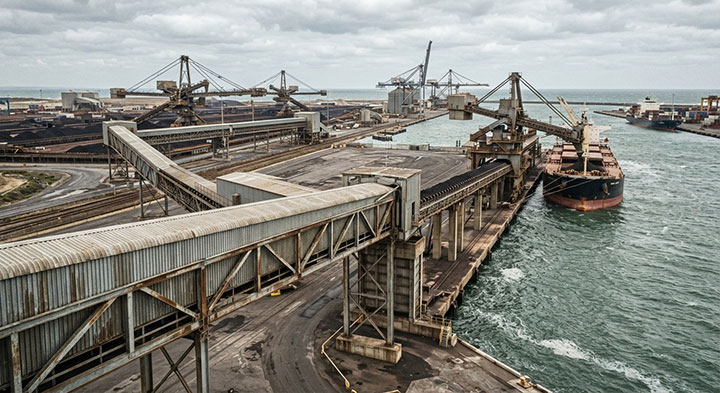
Bulk Ports & Marine Terminals: Connecting inland stockyards to coastal ship-loading docks, ensuring massive throughput capacity for international raw material export and import.
Cement & Aggregate Production Plants: Moving limestone, clay, and clinker across inter-plant distances, bridging quarries and manufacturing sites separated by highways, rivers, or valleys.
Coal-Fired Power Stations & Energy Facilities: Handling continuous, high-volume coal transport from unloading terminals or regional mines directly to power plant storage bunkers.
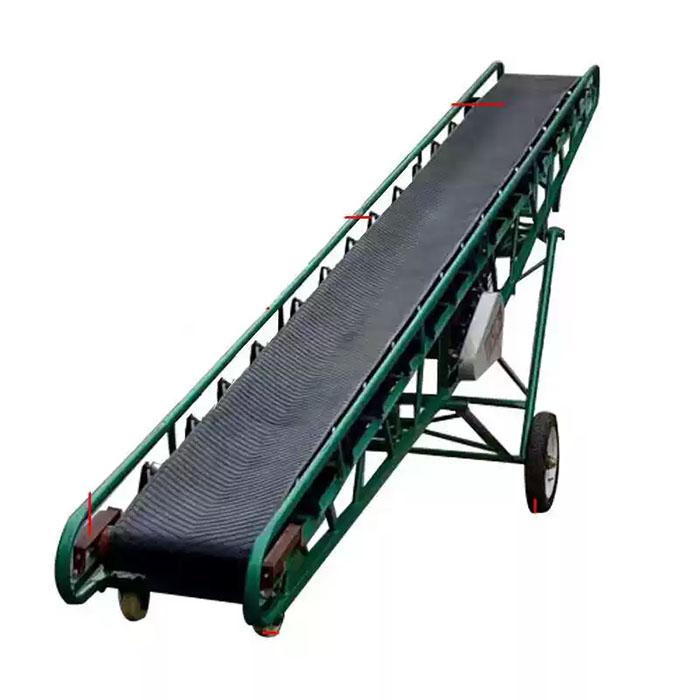
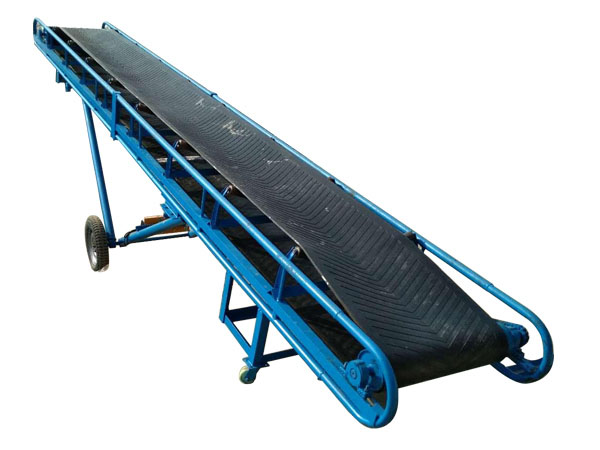
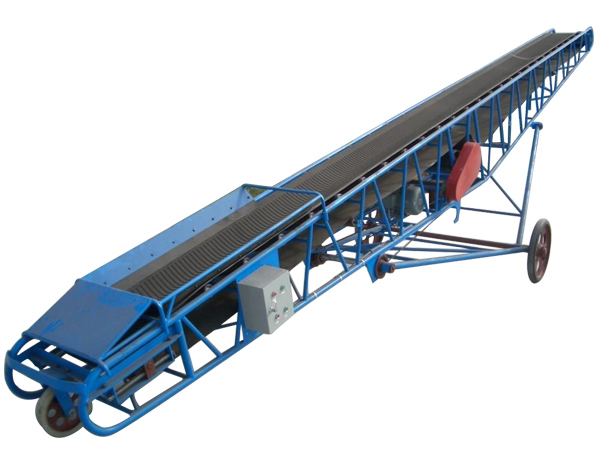
While overland conveyors manage mass long-distance transport, we also specialize in compact, mobile industrial conveying solutions for internal factory material handling:
When evaluating high-volume, long-distance bulk transport, project owners frequently compare continuous conveyor systems with conventional off-highway dump truck fleets. The economic and operational comparison highlights distinct advantages:
| Evaluation Metric | Overland Conveyor Systems | Traditional Truck Haulage |
|---|---|---|
| Operating Cost per Ton | Significantly lower due to continuous, automated bulk movement. | High, heavily impacted by fluctuating diesel fuel prices. |
| Labor & Personnel Requirement | Minimal centralized supervision and automated monitoring. | High labor overhead requiring large fleets of drivers and mechanics. |
| Maintenance & Downtime | Predictable scheduled servicing with long component lifespans. | Frequent wear and tear, tire replacements, and engine overhauls. |
| Terrain & Grade Limitations | Handles steep inclines and complex horizontal curves smoothly. | Restricted by steep climbing limits and safety switchbacks. |
Although the initial capital expenditure (CAPEX) for an overland conveyor requires careful planning, its dramatically lower operating expenditure (OPEX) ensures a rapid return on investment (ROI) over the project's lifecycle, making it the superior long-term choice for heavy industrial transport.
Deploying a successful long-distance conveying system demands rigorous engineering execution, from initial route surveying to on-site commissioning. Our proven field performance is demonstrated across demanding industrial environments:
Engineered a high-capacity overland system in a rugged mountainous region, utilizing steel cord belting and multi-point intermediate drives to navigate complex vertical and horizontal curves while eliminating intermediate transfer stations.
Designed and supplied a high-speed continuous bulk handling line connecting an inland mineral terminal directly to marine loading docks, maintaining stable 24/7 throughput under heavy coastal wind loads.
Implemented a fully enclosed long-distance conveyor spanning highways and uneven terrain to transport limestone and clinker securely, significantly reducing inter-plant logistics expenses.
Watch our heavy-duty conveyor systems in action, managing bulk material transport effectively within rugged mining and aggregate processing environments.
To ensure every long-distance conveying system matches the exact topographical and operational demands of your project, we provide comprehensive, end-to-end engineering services:
Route Survey & Topographical Analysis: Evaluating site geography, elevation profiles, obstacles, and environmental conditions to determine the optimal conveying path and minimize civil construction costs.
Dynamic Tension & Power Calculation: Utilizing advanced engineering software to calculate belt tension, start-up torque, braking requirements, and power distribution in accordance with international standards.
Tailored System & Component Engineering: Customizing steel cord specifications, drive stations, idler spacing, and safety protection networks to fit your exact throughput and material characteristics.
Manufacturing, Quality Control & Global Delivery: Rigorous in-house fabrication of all structural components and mechanical parts, followed by strict quality inspection prior to international shipping.
On-Site Installation Guidance & Commissioning: Providing professional technical support, assembly supervision, and system commissioning to ensure safe, stable start-up and long-term reliable operation.
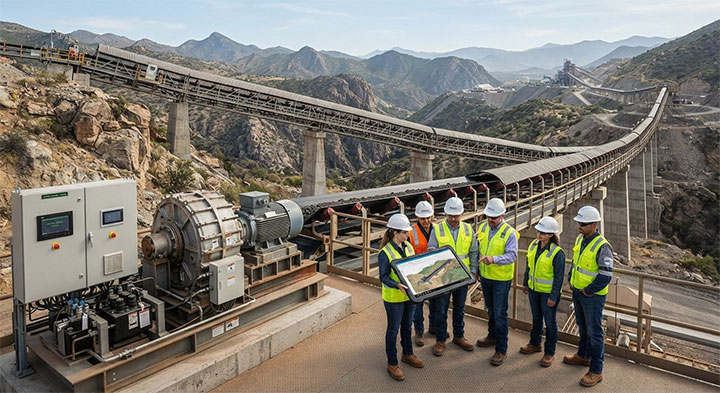
A single-flight overland conveyor can typically span up to 5 kilometers or more, depending on the tensile strength of the steel cord belt (such as St3000 to St4500) and the power distribution of the drive stations.
By engineering appropriate transition radii, optimizing idler troughing angles, and managing belt tension profiles, the system can smoothly navigate natural terrain contours without requiring costly intermediate transfer towers.
Steel cord conveyor belts are standard for long-distance applications because they offer high tensile strength, excellent impact resistance, and extremely low elongation under heavy continuous loads.
Downhill sections utilize regenerative braking systems that convert the potential energy of descending materials into electrical power, feeding it back into the plant's electrical grid.
To provide an accurate engineering proposal, we need your project's material type, bulk density, required hourly throughput (t/h), total conveying distance, elevation profile, and site terrain details.
To receive a customized engineering proposal, layout drawing, and competitive quotation for your project, please provide our engineering team with your core parameters:
Contact our engineering experts today to discuss your project requirements.
CONTACT
WhatsApp:+86 18339211009
Email:sale@xxdahan.com
Add:China, Henan Province, Xinxiang City.Yanjin county forest park gate to the west 1000 meters north road