E-mail: sale@xxdahan.com
Follow Us 


Welcome to the definitive guide on the Portable Belt Conveyor . If you are searching for a flexible, cost-effective material handling solution, a portable conveyor system might be the answer. This guide explores everything from the mobile conveyor's design and applications to its advantages and limitations. We'll also compare it to fixed systems to help you decide, but first, let's define what makes a portable belt conveyor unique.
When planning a bulk material handling system, one of the first decisions you will face is whether to use a portable belt conveyor or a fixed belt conveyor. Both systems have their place in industrial operations, but they serve fundamentally different purposes and are suited to different types of projects.
Choosing the wrong type can lead to operational inefficiencies, unnecessary capital expenditure, and ongoing frustration. Choosing the right type, however, can streamline your workflow, reduce labor costs, and provide years of reliable service.
This article provides a detailed comparison of portable and fixed belt conveyors, helping you evaluate which configuration aligns with your project requirements, site conditions, and operational goals.
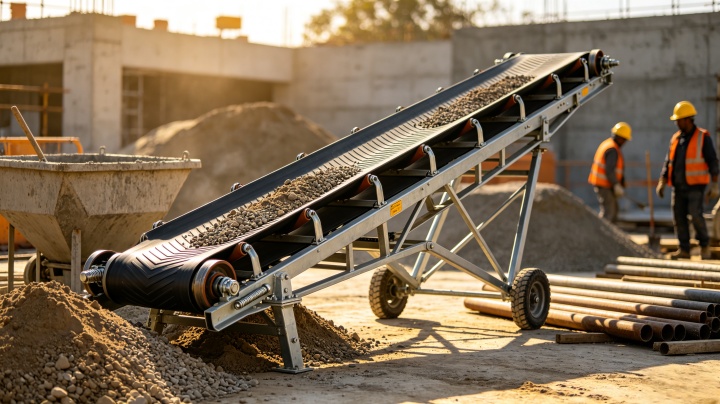
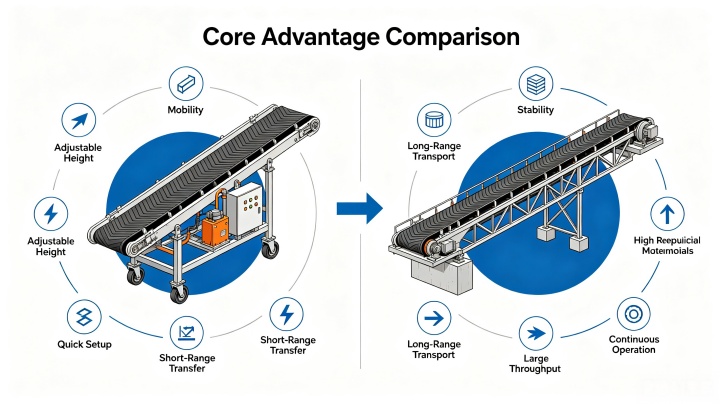
A portable belt conveyor is a mobile material handling unit designed for flexibility and ease of relocation. These conveyors are mounted on wheeled frames or skids, allowing them to be moved manually or towed to different positions within a job site or between multiple sites.
Key Characteristics:
Typical Applications:
Common Models: The DY series is one of the most widely recognized portable conveyor configurations, featuring adjustable conveying angles (10°–26°), various belt widths (500–1000mm), and capacities ranging from 50 to 550 cubic meters per hour depending on the model and specifications.
For more specific models, explore our range of DY series portable belt conveyors or learn about our fixed conveyor systems.
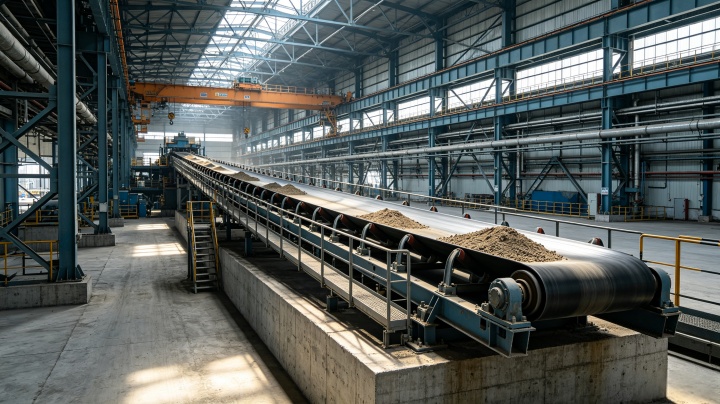
A fixed belt conveyor is a permanent material handling installation anchored to a specific location. These systems are engineered for continuous, high-capacity operation over extended periods and are typically integrated into broader processing or production facilities.
Key Characteristics:
Typical Applications:
Common Configurations: Fixed belt conveyors are typically part of larger engineering systems, often enclosed in structures or covered for environmental protection. They come in a wide range of sizes, capacities, and custom configurations to match specific facility designs and production requirements.
Portable: If your material pickup or discharge points change frequently, or if you work on multiple project sites, the mobility of a portable conveyor is a significant advantage. A single unit can serve different areas of a construction site as the work progresses, eliminating the need for multiple conveyors or manual material movement. Relocation takes minutes to hours, and the same unit can be reused across multiple projects.
Fixed: If your material flow is stable and unchanging, the lack of mobility is not a drawback. The conveyor becomes a permanent part of your facility infrastructure, moving materials along a dedicated path without requiring adjustment. However, relocating a fixed conveyor is rarely practical and typically requires major disassembly and reinstallation.
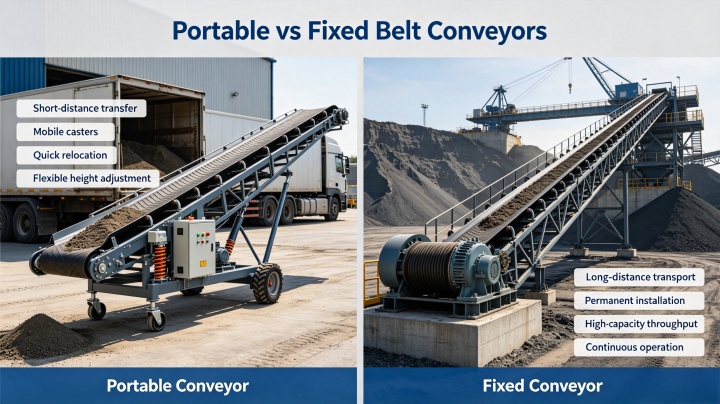
Portable: The absence of foundation requirements is one of the primary advantages of portable conveyors. You can place the unit on reasonably level ground and begin operation immediately. No civil works are needed, and installation cost is effectively included in the purchase price. This feature is particularly valuable for temporary projects or operations where site conditions are uncertain.
Fixed: The installation of a fixed conveyor system is a major engineering project. It typically requires site preparation, concrete foundation construction, structural steel installation, and integration with other facility systems. These upfront costs can significantly exceed the equipment purchase price, and installation timelines often span days to weeks rather than hours.
| Aspect | Portable Belt Conveyor | Fixed Belt Conveyor |
| Typical conveying distance | 5–20 meters | 50–1,000+ meters |
| Typical capacity range | 50–550 m³/h | 500–10,000+ m³/h |
| Belt width range | 400–1,200 mm | 800–2,400+ mm |
| Motor power range | 1.5–15 kW | 30–1,000+ kW |
Portable: Portable conveyors are limited in length by their mobile design. Longer units become difficult to maneuver and transport. They are best suited for short-distance material movement, such as truck loading, stockpile management, and feeding equipment at close range.
Fixed: Fixed systems are designed for high-capacity, long-distance conveying. They can extend for hundreds of meters or even kilometers, with massive drive systems and robust construction to handle continuous operation. If your application requires moving materials over long distances or at very high volumes, a fixed conveyor is typically the only practical option.
Portable: The ability to adjust height and angle is a core feature of portable conveyors. Hydraulic lifting mechanisms allow operators to raise or lower the discharge end to match truck beds, hoppers, or stockpile heights. The inclination angle can typically be adjusted within a 10°–26° range as needed during operation. This flexibility is essential when serving multiple loading points with different elevation requirements.
Fixed: Fixed conveyors are typically designed with a constant angle and discharge height. While some systems include limited adjustability through telescoping features or multiple discharge points, these are exceptions rather than the rule. The fixed nature is acceptable when material destinations are consistent and do not change over time.
| Aspect | Portable Belt Conveyor | Fixed Belt Conveyor |
| Initial equipment cost | Lower | Higher |
| Installation and foundation cost | None | Significant |
| Maintenance complexity | Lower | Higher |
| Expected service life | 5–10 years | 15–25 years |
Portable: Portable conveyors represent a lower initial investment and require no civil works. This makes them accessible to smaller operations, contractors, or projects with limited budgets. The equipment can be sold or moved to another site when the current project ends, preserving capital value.
Fixed: Fixed conveyors require substantial capital investment not only for the equipment but also for installation, foundations, and supporting infrastructure. However, for continuous, large-scale operations, this investment is often justified by lower per-ton conveying costs over the life of the facility.
| Your Project Characteristics | Likely Best Choice |
| Multiple material points, short distances, temporary operation | Portable Belt Conveyor |
| Single material point, long distance, permanent facility | Fixed Belt Conveyor |
| Short-term project, limited budget, seasonal operation | Portable Belt Conveyor |
| Continuous 24/7 operation, large volumes, long-term | Fixed Belt Conveyor |
| Construction site with changing work areas | Portable Belt Conveyor |
| Dedicated production line integrated with other equipment | Fixed Belt Conveyor |
| Aspect | Portable Belt Conveyor | Fixed Belt Conveyor |
| Best use case | Flexible, short-term, varying locations | Permanent, high-capacity, long-term |
| Mobility | High | None |
| Installation | No foundation | Requires civil works |
| Conveying distance | 5–20 m typical | 50–1,000+ m |
| Capacity range | 50–550 m³/h | 500–10,000+ m³/h |
| Height adjustment | Hydraulic/manual | Fixed |
| Initial cost | Lower | Higher |
| Service life | 5–10 years | 15–25 years |
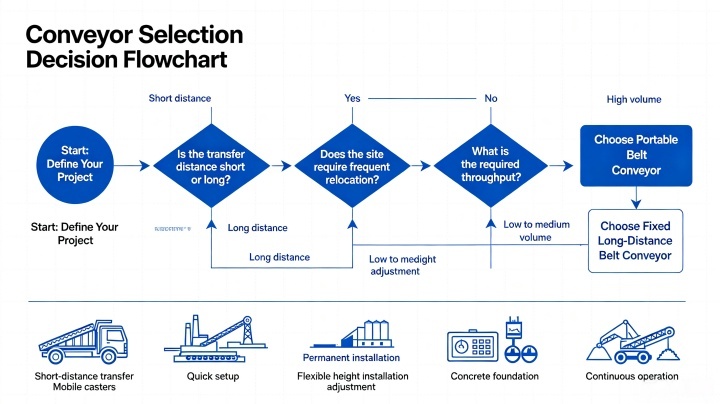
Choose a portable belt conveyor if your material handling points change frequently, your project is temporary or seasonal, you need quick setup and relocation, and your conveying distances are relatively short.
Choose a fixed belt conveyor if your material flow is permanent and stable, your operation runs continuously, you require long-distance conveying, and you have dedicated space for permanent infrastructure.
Assess your application honestly, consider both immediate and long-term needs, and make your decision based on the specific demands of your project rather than general assumptions about either system type.
CONTACT
WhatsApp:+86 18339211009
Email:sale@xxdahan.com
Add:China, Henan Province, Xinxiang City.Yanjin county forest park gate to the west 1000 meters north road