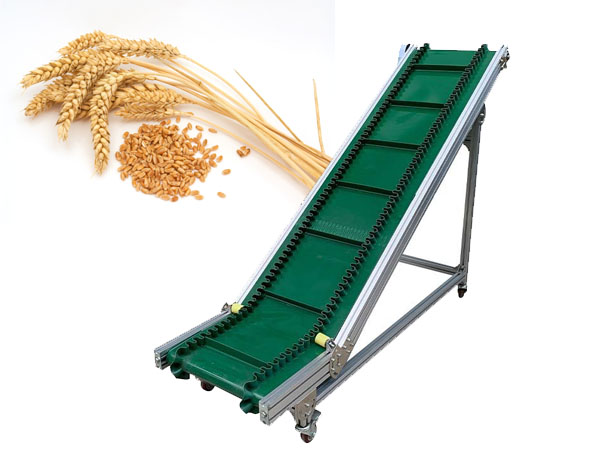
Cleated Belt Conveyor for Grain
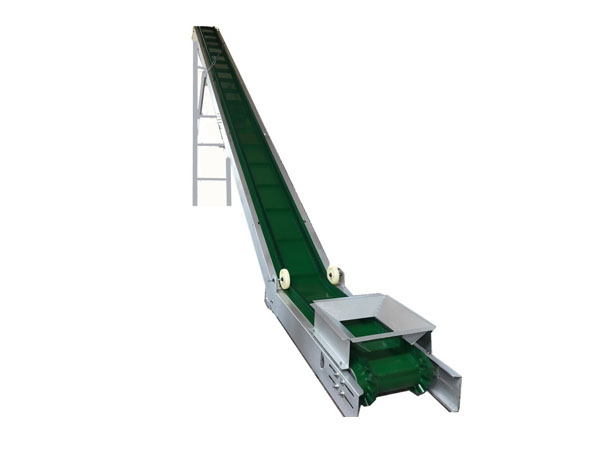
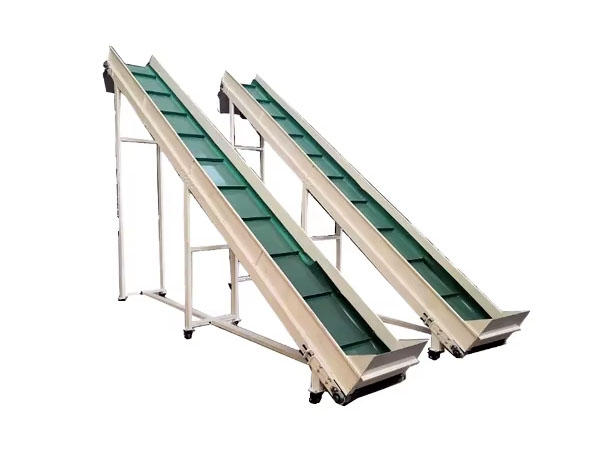
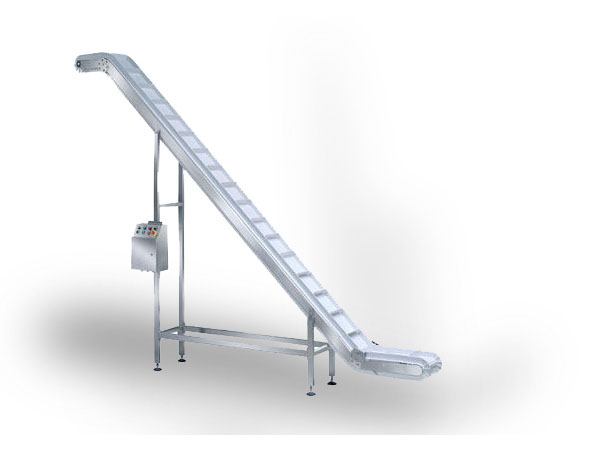
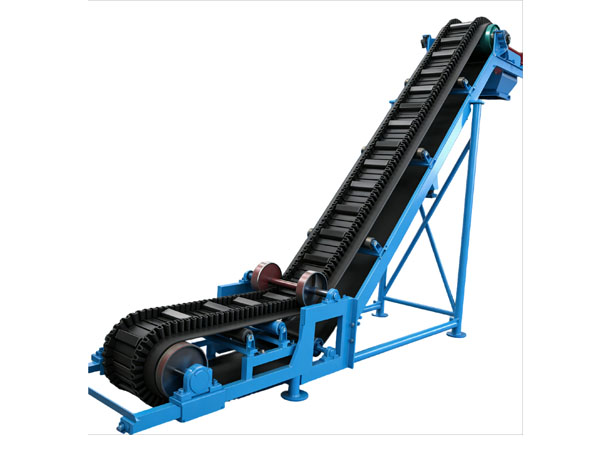
The Cleated Belt Conveyor for Grain is a type of conveyor belt designed with baffles to enable continuous transport of grain horizontally, at inclines, or even at large angles. The baffle design effectively prevents grain from slipping back, spilling, and breaking.
Conveying capacity: 10–160 t/h
Conveying width: 300–1200 mm
Conveying length: 3–30 m
Conveying angle: 0–90°
Conveying speed: 0.3–2.5 m/s
Baffle height: 20–120 mm
What is a Cleated Belt Conveyor for Grain?
A Cleated Belt Conveyor for Grain is a machine for continuous grain conveying. By adding baffles and corrugated sidewalls to the conveyor belt surface, it can convey grain horizontally, inclined, and even at large angles, effectively preventing grain spillage and overflow during transport. Conveying lengths can reach 30 meters, and belt widths are available in various specifications such as 400mm, 500mm, 600mm, 800mm, 1000mm, 1200mm, and 1400mm. Custom belt widths can also be customized to meet specific requirements.
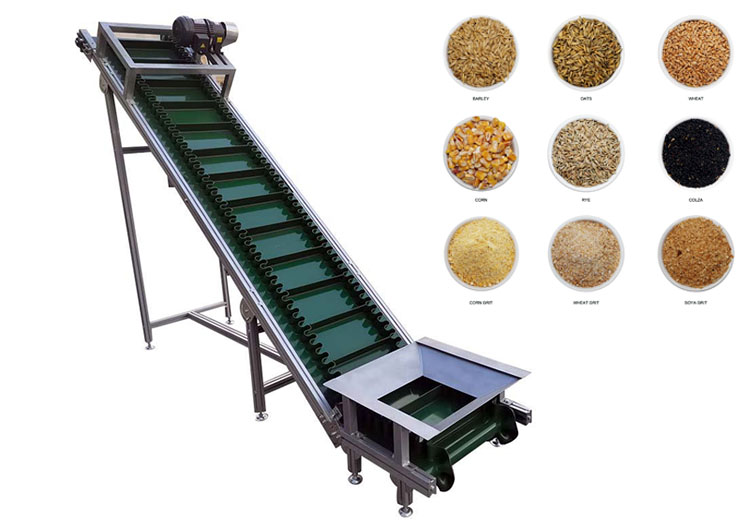
The Cleated Belt Conveyor for Grain solves the problems of grain slippage, accumulation, and backflow that occur with ordinary belts at angles exceeding 18°. It is particularly suitable for conveying highly mobile bulk materials such as wheat, corn, and rice. It offers stable operation and a high degree of automation, meeting the continuous production needs of grain silos, grain processing plants, agricultural production lines, and loading systems.
Why choose a Cleated Belt Conveyor for grain conveying?
Grain is a highly mobile, easily scattered, and, in some varieties, fragile material. Traditional conveying methods often suffer from low efficiency and significant on-site pollution. The Cleated Belt Conveyor effectively solves these problems.
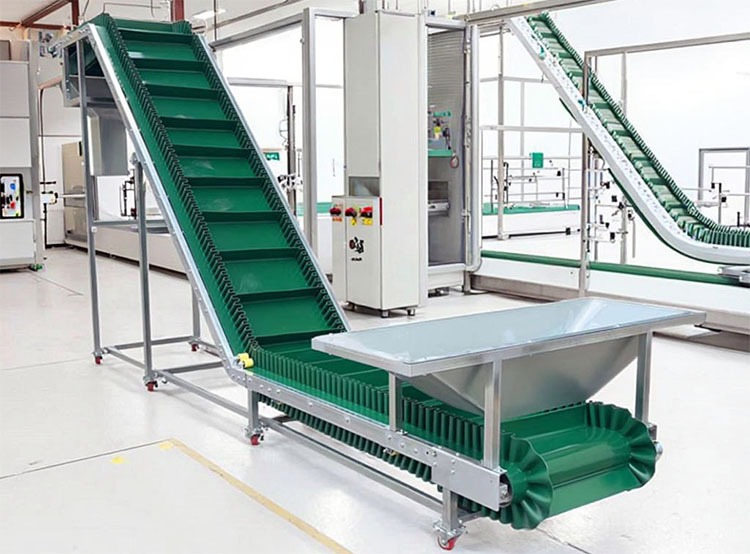
Prevents grain slippage: The baffle structure forms an independent material bin, ensuring stable conveying even at large angles of inclination.
Reduces grain spillage: An optional skirt structure reduces particle overflow during conveying.
Reduces grain breakage rate: Employs a flexible conveying method, gentler than screw conveyors and bucket elevators.
Saves installation space: Supports inclined conveying and vertical lifting layouts, as well as continuous feeding and unloading, reducing manual handling.
What are the structural components of the Cleated Belt Conveyor for Grain?
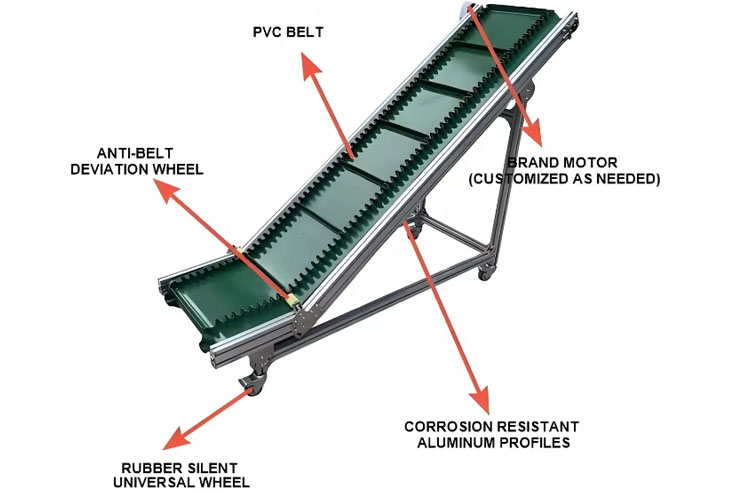
A cleated belt conveyor for grain typically consists of a conveyor belt, baffles, skirts, a drive system, and a conveyor frame. The conveyor belt can be made of food-grade PVC, PU, or rubber, depending on the grain type. Baffles are generally 20–120mm high, used to support the grain and prevent slippage; their height can be customized. The conveyor frame is available in carbon steel and stainless steel, selectable based on the site conditions.
How does a cleated belt conveyor for grain work?
During operation, grain enters the conveyor belt through the inlet. As the drive unit propels the belt continuously, the baffles hold the grain within the conveying area and move it in a predetermined direction. Upon reaching the outlet, the grain is automatically unloaded by gravity. The entire conveying process is continuous and stable, enabling long-distance, multi-angle material transfer.
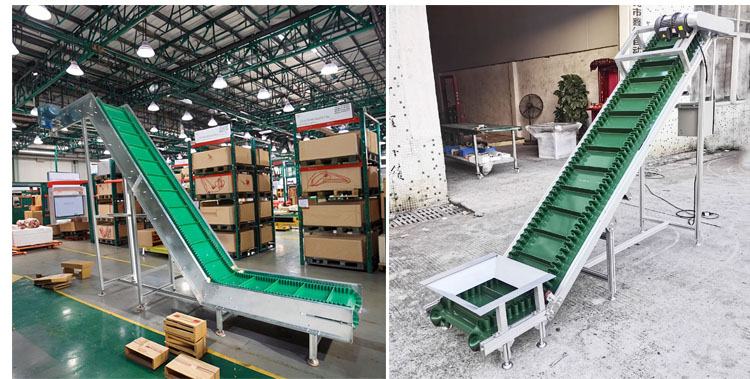
Cleated belt conveyor for grain parameters
| bandwidthB(mm) | 300 | 400 | 500 | 650 | 800 | |||||||||
| sidewall height(mm) | 40 | 60 | 60 | 80 | 80 | 120 | 120 | 160 | 120 | 160 | 200 | 240 | ||
| Partial conveying inclination conveying amountQ3/h | 30° | 15 | 14 | 20 | 34 | 46 | 71 | 104 | 120 | 128 | 157 | 195 | 235 | |
| 45° | 11 | 10 | 14 | 26 | 35 | 57 | 83 | 97 | 102 | 127 | 157 | 195 | ||
| 60° | 8 | 7 | 10 | 18 | 25 | 40 | 58 | 69 | 72 | 90 | 112 | 142 | ||
| 90° | 4 | 4 | 5 | 10 | 13 | 21 | 31 | 37 | 38 | 48 | 60 | 76 | ||
| Dimensions | Head wheel center heightH2/h(MM) | 350-100 | 1100-2000 | 1300-2000 | 1300-2000 | |||||||||
| Tail wheel center heightH2/h(MM) | 335 | 330-490 | 600 | 600 | 600-800 | |||||||||
| Middle section belt heightH2/h(MM) | 450 | 500-700 | 760-800 | 800-850 | 800-1115 | |||||||||
| Middle foot widthB2/h(MM) | 480 | 580 | 870 | 1020 | 1220 | |||||||||
| bandwidthB(mm) | 1000 | 1200 | 1400 | |||||||||||
| sidewall height(mm) | 120 | 160 | 200 | 240 | 160 | 200 | 240 | 300 | 160 | 200 | 240 | 300 | 400 | |
| Partial conveying inclination conveying amountQ3/h | 30° | 172 | 216 | 267 | 327 | 275 | 331 | 419 | 466 | 319 | 395 | 500 | 564 | 794 |
| 45° | 137 | 175 | 216 | 271 | 222 | 267 | 347 | 384 | 258 | 318 | 414 | 465 | 680 | |
| 60° | 96 | 124 | 153 | 197 | 158 | 190 | 253 | 178 | 184 | 226 | 302 | 337 | 524 | |
| 90° | 51 | 66 | 83 | 106 | 85 | 102 | 136 | 149 | 98 | 121 | 162 | 180 | 281 | |
| Dimensions | Head wheel center heightH2/h(MM) | 1400-2000 | 1600-2000 | |||||||||||
| Tail wheel center heightH2/h(MM) | 600-800 | 800-1000 | 800-1200 | |||||||||||
| Middle section belt heightH2/h(MM) | 800-1200 | 1050-1500 | 1050-1700 | |||||||||||
| Middle foot widthB2/h(MM) | 1440 | 1690 | 1890 | |||||||||||
What are the applications of a cleated belt conveyor for grain?
The Cleated Belt Conveyor for Grain can be used for conveying various granular grains and agricultural products, such as wheat, corn, rice, soybeans, sorghum, oats, feed pellets, beans, peanuts, and grain mixtures. It is suitable for different conveying scenarios, such as automated grain inbound and outbound conveying in grain storage systems; conveying grains before and after cleaning, screening, and packaging on grain processing production lines; conveying pelleted feed and mixed raw materials in feed processing plants; and handling bulk grain loading and unloading operations in port and loading systems.
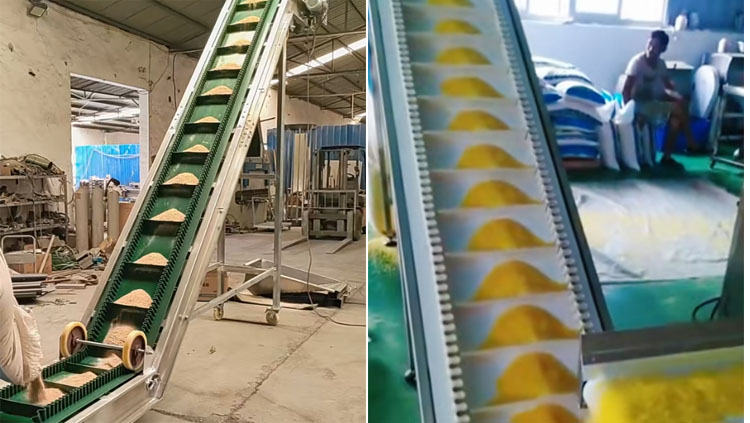
Cleated Belt Conveyor for Grain Customer Case
An Indian grain processing company needed to lift corn from the raw material area to the packaging area. With limited space, traditional horizontal conveying could not meet the requirements. They purchased Dahan's Cleated Belt Conveyor for Grain for conveying corn at a 45-degree angle, with a conveying length of 12 meters. The conveyor belt used food-grade PVC baffle belts. After the project was put into operation, continuous automated conveying was achieved, with a conveying capacity of 80 tons per hour, reducing manual labor by approximately 60% and significantly reducing material spillage on site.
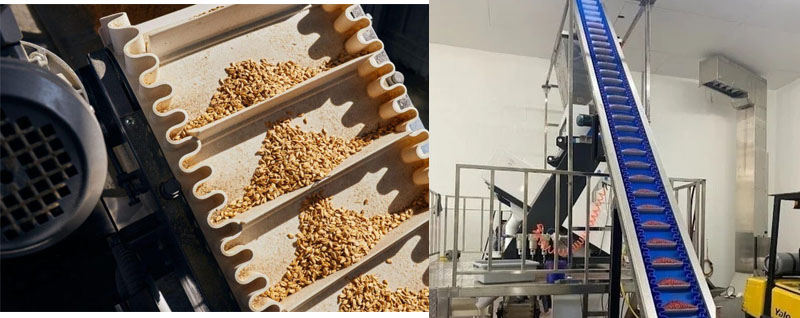
Frequently Asked Questions about Cleated Belt Conveyor for Grain
Q: What is the maximum vertical lift angle for the Cleated Belt Conveyor for Grain?
A: It is typically designed to be below 45°. Special configurations can approach 90° vertical lift, but for grains, a maximum of 45° is generally recommended to maintain filling efficiency and low breakage.
Q: Is it necessary to change belts when conveying different grains?
A: No belt change is required. The spacing of the crossbars and side blocks is designed for all commonly used grains. When changing grains, simply empty the conveyor belt and rinse it to avoid cross-contamination.
Q: Can it handle grains with high moisture content or impurities?
A: Yes. For materials with high moisture content (e.g., 30% moisture in wet corn) or containing a small amount of straw, deep baffles, wide-spaced partitions, and special cleaning devices can be selected to ensure no material gets stuck.
Q: Does it provide food-grade certification?
A: Yes. Both rubber and PU belts can provide FDA/EU food contact material certification, meeting food-grade grain handling requirements.
Q: Can it be made mobile?
A: The standard design includes a mobile version, equipped with wheels and a tow rack, which is moved by a tractor or electric winch and is ideal for farms or grain collection points with multiple warehouses operating in rotation.