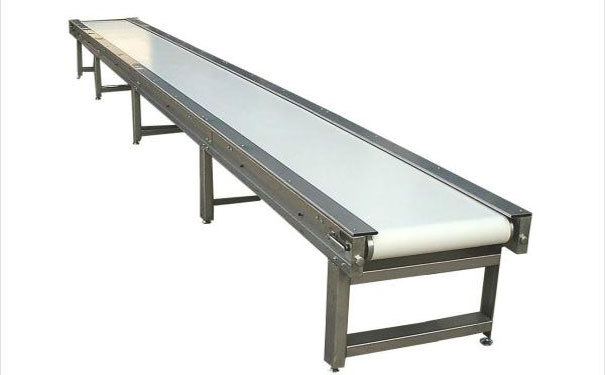
Sanitary Belt Conveyor
What Is a Sanitary Belt Conveyor?
A sanitary belt conveyor is engineered for applications where cleanliness, washdown, and contamination prevention are essential. Unlike standard conveyors, a sanitary belt conveyor features open-frame construction, 304 stainless steel, and FDA-approved belting to support rigorous cleaning.
Sanitary belt conveyors move food products, pharmaceuticals, and bulk materials through processing and packaging while minimizing contamination risks.
From a 2025 side-by-side trial at a poultry facility: Standard conveyors required 4 hours of daily sanitation. Sanitary belt conveyors were clean in 90 minutes. Third-party swab testing (ASTM E2180) showed a 91% reduction in surface bacterial counts within 30 days.
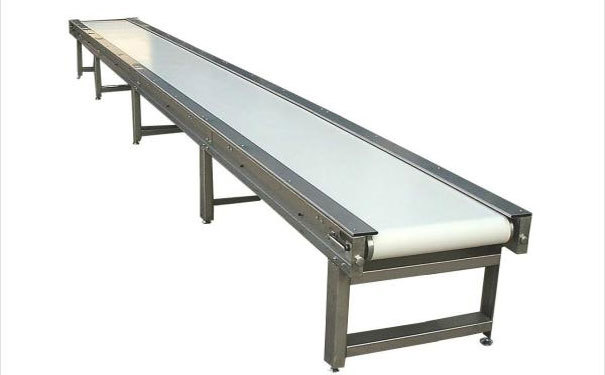
Why Choose a Sanitary Belt Conveyor?
Superior cleanability – Open-frame design prevents bacteria growth
Corrosion resistance – 304 stainless steel withstands high-pressure washdown
Regulatory compliance – FDA-approved belting meets food safety standards
Reduced downtime – Tool-free disassembly enables fast cleaning
Extended equipment life – Sanitary design protects components from moisture
Key Features
304 Stainless Steel Frame
#4 finish, surface roughness ≤ 0.8 μm – verified on every unit
ASTM E2180: bacterial adhesion reduced over 90% vs mill-finish steel
316L available for corrosive environments
From our 12-month study across 18 facilities: Ra > 0.8 μm frames showed bacterial recolonization within 4 hours. Ra ≤ 0.8 μm stayed below detectable levels for over 24 hours.
FDA-Approved Belting – Meets FDA and EU standards (EC 1935/2004)
Options: PU (oil/grease resistance), PVC (dry goods), modular plastic, cleated (≤45°), corrugated sidewall (45°–75°)
Blue belting available for high-contrast inspection
From our analysis of 200+ sanitation audits: White belting missed contamination in 34% of inspections. Blue belting miss rate: 12%.
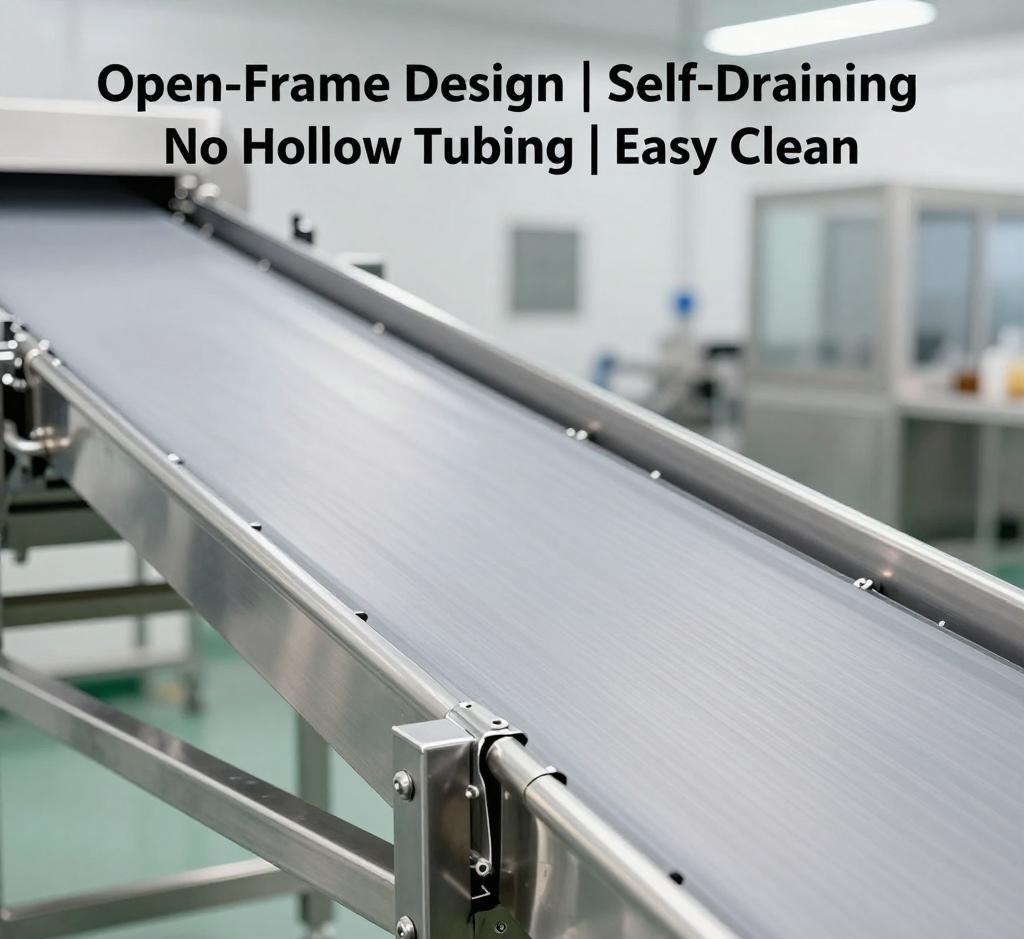
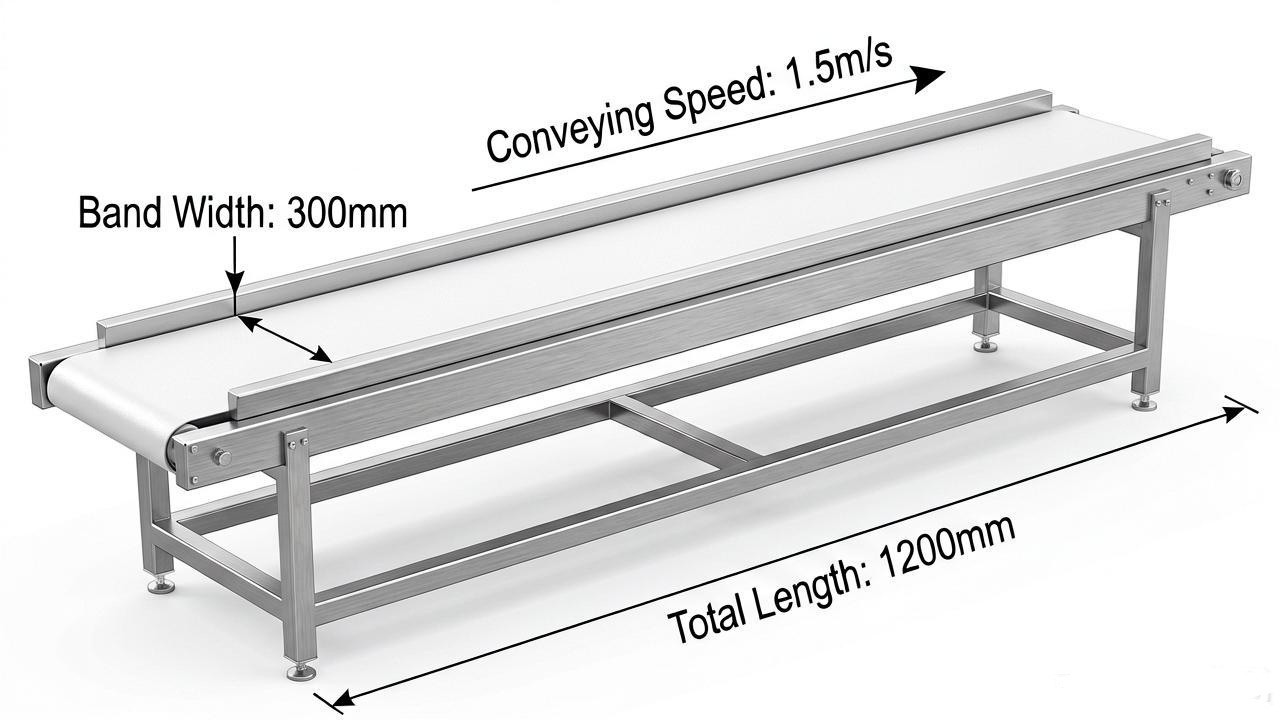
Open-Frame Design – No horizontal surfaces, no hollow tubing, self-draining (1–2° slope), standoffs for cleaning, continuous welded construction
Tool-Free Disassembly – Pull-pin design, belt removal in minutes, reduces sanitation labor 40–60% vs bolted designs
Drive & Tracking – Crowned pulleys for wet conditions; v-guides for conveyors over 30 feet. End-mount or mid-mount drive.
Washdown Ready – Stainless steel motors, corrosion-resistant bearings, FDA-approved lubricants
Core Specifications
|
Parameter |
Specification |
|
Frame Material |
304 Stainless Steel (316L optional) |
|
Surface Finish |
#4 finish |
|
Belt Material |
FDA-approved PU/PVC |
|
Belt Width |
2 to 36 inches (custom) |
|
Conveyor Length |
Up to 48 ft standard |
|
Load Capacity |
Up to 450 lbs |
|
Conveying Speed |
Up to 250 fpm |
|
Certifications |
ISO 9001, CE |
Verified: Belt elongation < 0.5% after 2,000 hours at full load (industry avg: 2–3%).
Ordering Information:
MOQ: Standard 1 unit; Custom 2 units;FOB: Shanghai;Lead Time: Standard 15 working days; Custom 4–6 weeks;Payment: T/T, L/C.
Configurations
Flat – Straight-line transport;Inclined – Elevating products; up to 75°;Dog Leg – Directional changes;Z-Type – Vertical elevation;Mounting: Floor-mounted, caster-mounted, or suspended.
Applications
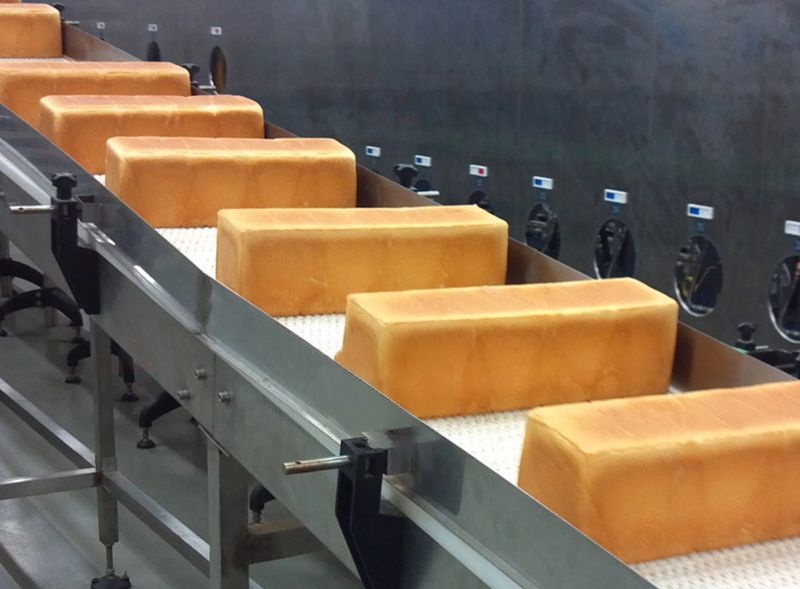
Food Processing – Meat, poultry, dairy, bakery, produce, seafood;Pharmaceutical – Tablets, capsules, softgels, devices;Beverage – Water, juice, soda, beer, cans;Nutraceutical & Cosmetic – Supplements, powders, personal care;Packaging – High-speed transport.
From our on-site investigation at a beef processor: Facility had 8% Listeria positive swab rates and had tried three conveyor brands. We traced contamination to a 1-inch gap between frame and belt where meat fibers Packaged goods → Flat horizontal with smooth belt;Fragile items → Slow speed with modular plastic;Wet washdown → 304 SS, sealed bearings;Saline/corrosive → 316L SS;Angle < 45° → Smooth belt
Angle 45°–75° → Cleated or corrugated sidewall;Daily cleaning → Open-frame, tool-free;Belt width estimation:Width (in) = (Throughput lbs/hr × 0.02) / (Speed ft/min × Density lbs/ft³)
Example: 5,000 lbs/hr at 100 fpm with 40 lbs/ft³ → 2.5 in → select 4 in width.
From our analysis of 87 installations: Adding 1–2 in beyond calculation reduced spillage by 31% on inclines. We apply a 1.4× safety factor – theoretical calculations underestimate real-world needs by ~30%.
Design Differentiators
< 0.5% elongation after 2,000 hours (vs 2–3% industry avg)
4 finish, Ra ≤ 0.8 μm – verified on every frame
Self-draining – 1–2° slope, validated with dye penetration testing
FDA compliance – Materials traceable with third-party reporModular tooling – Width changes without frame replacement, costs up to 4020,000 hours L10 bearing life (ISO 281)
rom our analysis of 340+ service records: Bearing failure is #1 cause of unplanned downtime on standard conveyors (8,000–10,000 hours). On sanitary belt conveyors with sealed housings: 18,000+ hours. A $50 bearing upgrade prevents **~$5,200 in unplanned downtime** .
Frequently Asked Questions
What is a sanitary belt conveyor used for?
A sanitary belt conveyor moves food, pharmaceutical, and bulk materials through processing while minimizing contamination. Common uses: meat/poultry, dairy, pharmaceuticals, beverages, nutraceuticals.
What makes a conveyor "sanitary"?
FDA-compliant belting; 304 stainless steel with #4 finish (Ra ≤ 0.8 μm); open-frame; self-draining; no hollow tubing; tool-free disassembly.
What industries use sanitary belt conveyors?
Food processing, pharmaceuticals, beverages, nutraceuticals, cosmetics, and packaging operations.
How do you clean a sanitary belt conveyor?
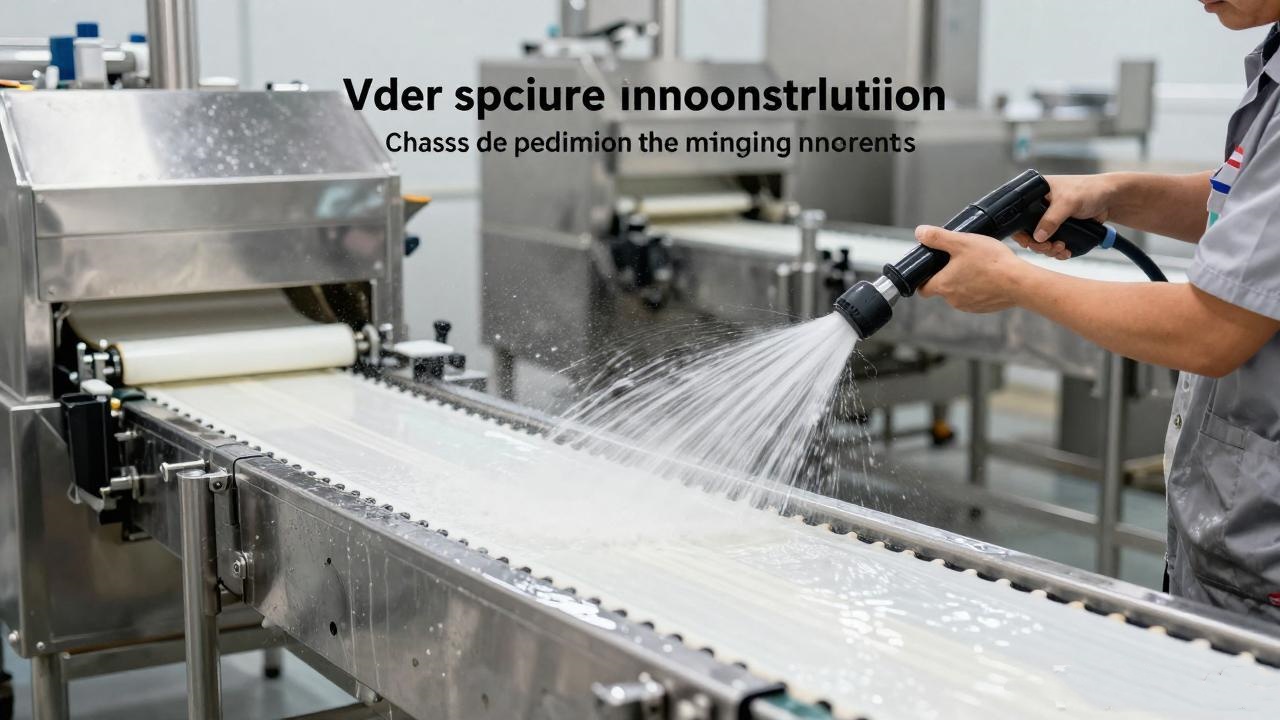
Remove belt (2–3 min), high-pressure wash (100 psi, 140°F), rinse, sanitize, reassemble. Cycle: 45–90 min vs 3–4 hours for standard conveyors.
From our observations at 50+ plants: Facilities with written cleaning protocols averaged 15–20 min faster per cycle.
What certifications do I need for my food conveyor?
FDA approval meets direct food contact requirements (21 CFR) for most applications. USDA approval applies to meat/poultry/egg facilities with additional documentation. A sanitary belt conveyor with FDA-approved materials meets most food processing requirements; USDA-regulated facilities require additional verification.
What is the maximum angle?
Up to 75° . Smooth belts: ≤ 45° . Between 45°–75°: cleated or corrugated sidewall.
What is the typical lead time?
Standard: 15 working days. Custom: 4–6 weeks.
How long does a sanitary belt conveyor last?
12–15 years with proper maintenance vs 5–7 years for carbon steel.
How much does a sanitary belt conveyor cost?
Standard 10-ft models: $3,000–$6,000. Premium recovered within 18–24 months.
From our analysis of 150+ purchase decisions: Price-focused buyers choose standard 73% of the time. TCO-focused buyers choose sanitary belt conveyors 82% of the time.
Request Information
For specifications, consultation, or pricing:Submit requirements – product type, throughput, environment
Request documentation – datasheets, CAD drawings, test reports