E-mail: sale@xxdahan.com
Follow Us 


If you are still loading trucks manually, you are leaving money on the dock. Selecting the optimal Truck Loading Conveyor is now a strategic decision. In 2026, the automated truck loading system market is valued at approximately $3.5 billion. This guide provides a structured framework to help you choose the best truck loading conveyor for your specific operation, avoiding common pitfalls.
The logistics industry has reached a turning point. In 2026, the automated truck loading system market is valued at approximately $3.5 billion and is projected to grow at a compound annual growth rate of 7.5% through 2030. This growth is not driven by hype—it is driven by structural pressures that affect every warehouse and distribution center: rising labor costs, labor scarcity, tighter delivery windows, and the need to move more freight through existing buildings without expanding square footage.
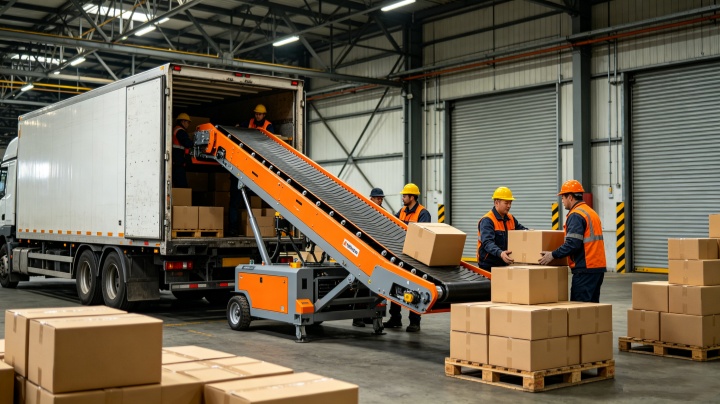
Truck loading conveyors have moved from a "nice-to-have" convenience to a strategic investment in dock throughput and operational resilience. But with multiple design families, dozens of suppliers, and price points ranging from a few hundred to over $100,000 per unit, how do you choose the right system for your operation?
This guide walks you through a structured decision-making process—from understanding the four main conveyor types to evaluating suppliers and avoiding common implementation pitfalls.
The most useful comparison does not start with brochures. It starts with your loading profile: cartons or bags? Loose load or palletized? Floor-loaded trailer or rigid unit load?
| Conveyor Type | Best For | Price Range | Key Advantage |
| Telescopic Belt Conveyors | Carton-intensive docks, high SKU variety, manual case loading | $3,650–$50,000+ | Extends deep into trailer, reduces walking distance, ergonomic benefit |
| Flexible Roller Conveyors | Variable dock use, seasonal overflow, low capital commitment | $350–$1,100/meter | Adaptable layout, portable, low-cost entry point |
| Slat/Chain Conveyors | Heavy or unstable loads (sacks, pails, industrial packs) | $6,000–$9,800 | Positive traction, handles difficult bottom surfaces |
| ATLS (Automatic Truck Loading Systems) | Repetitive, high-volume standardized pallet flows | $8,100–$100,000+ | Fully automated, minimal manual intervention |
Telescopic belt conveyors are the most common solution for parcel hubs and retail distribution centers. The mechanical design is straightforward: a fixed infeed conveyor with nested boom sections that extend into the trailer, allowing workers to place goods near the load face instead of walking cartons down the length of the vehicle.
Key specifications to consider:
Flexible conveyors are the low-commitment choice for mixed-use dock environments. They can be wheeled into position, curved to meet a trailer opening, and stored when not in use. Their advantage is not maximum throughput—it is adaptability and lower capital intensity.
When to choose flexible:
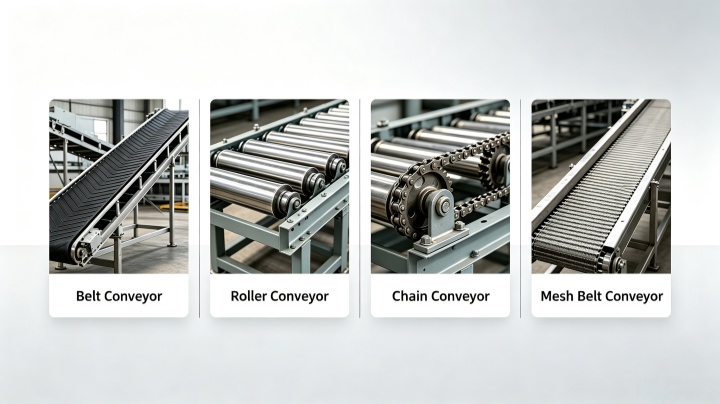
Slat conveyors and chain-driven trailer loaders occupy the middle ground. They are selected when packages are heavier, bottoms are less belt-friendly, or operators need more positive movement into the trailer. They handle sacks, pails, and industrial packs that might skew, drag, or stall on a belt.
Trade-off: Better load control, but higher maintenance concerns (chain elongation, slat damage, sprocket wear).
Automatic Truck Loading Systems (ATLS) represent the highest level of automation. These systems transfer full unit loads into trailers with minimal manual intervention. They make sense where freight consistency and volume are high enough to justify the capital investment—typically in beverage, tissue, consumer goods, and high-volume parcel operations.
Many buyers start with price comparisons. That is a mistake. Start with your freight profile.
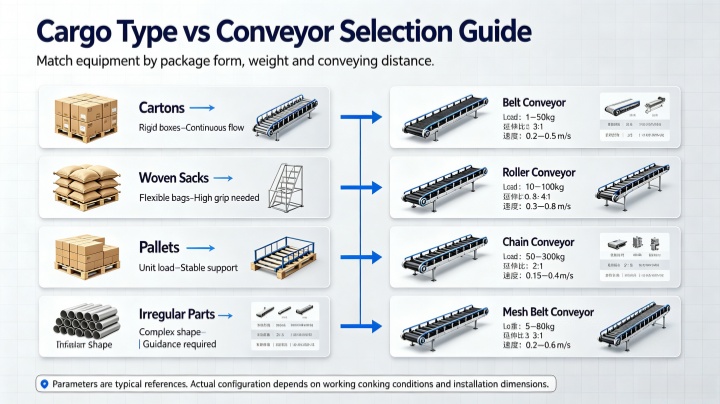
Consider these questions before you request a quote:
The table below illustrates typical fits:
| Freight Scenario | Typical Fit | Implementation Priority |
| Bags, parcels, loose cartons | Telescopic belt, flexible conveyors | Reduce walking, improve trailer fill speed |
| Mixed cartons for retail/e-commerce | Telescopic with scanning, weigh/dimension integration | Balance speed with load quality |
| Palletized outbound loads | Forklift loading, pallet conveyors, ATLS | Minimize dock time, reduce forklift traffic |
| Bulk/high-volume repetitive shipping | ATLS, skate or slat-based loaders | Justify capex through repeatability |
The takeaway: A conveyor that works for cartons may fail for bags. A system that fits parcel vans may not reach deep enough for 40ft containers. Match the equipment to your actual freight, not to what is on sale.
Selecting a conveyor supplier should be treated as a strategic partnership, not a transactional purchase. Here is what to look for:
Prices vary significantly based on design, customization, and automation level. Based on verified supplier data:
| Supplier | Product Type | Price Range | On-Time Delivery | Customization Level |
| Guangdong Jiabao | Belt & assembly line systems | $280/m–$6,000/set | 100% | High |
| Shandong Chenming | Roller & chain conveyors | $23–$25/10m–$6,000/set | 93% | Moderate |
| Xinxiang Hongda | Telescopic belt & portable units | $320–$3,650/set | 100% | Moderate |
| Xuzhou YCH | Automated & container loading systems | $8,100–$8,550/set | 100% | High (hydraulic, sensor integration) |
| Huayuan (Shenzhen) | Telescopic belt conveyor | $9,500–$11,000 | — | Moderate |
Note: Lower-cost options (under $1,000) often serve small warehouses or seasonal operations. Higher-end telescopic and automated systems ($8,000–$50,000+) include motorization, extendable booms, and integration capabilities.
For food processing, pharmaceuticals, or chemical handling, compliance is non-negotiable. Look for:
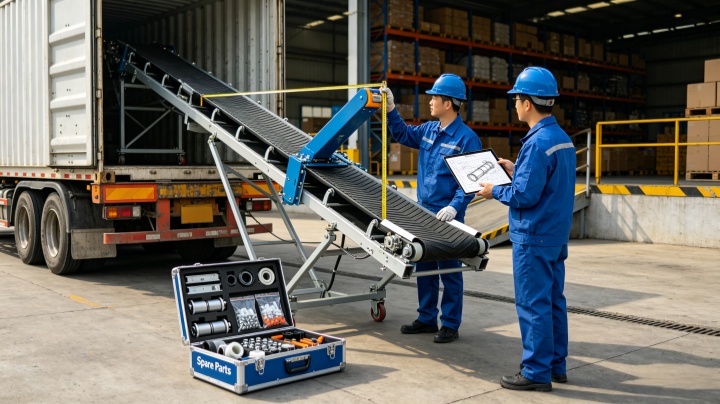
The strongest projects are not the ones with the most automation—they are the ones that account for loading constraints early. Several issues consistently separate successful implementations from disappointing installs:
For high-value orders, adopt a structured workflow to minimize risk:

Confirm spare parts availability and remote troubleshooting support before finalizing the purchase.
Choosing the right truck loading conveyor is not about picking the cheapest option or the most automated system. It is about matching the equipment to your freight profile, dock layout, and operational reality.
The market is moving toward mid-level loading automation—systems that improve ergonomics and throughput without requiring a full building redesign. For most operations, starting with telescopic belt or flexible conveyors at high-volume doors, validating labor and dwell reductions, and then scaling based on results is the most practical path.
By applying a structured evaluation process—understanding your freight, comparing system types, vetting suppliers on performance metrics, and planning for implementation constraints—you can turn your loading dock from a cost center into a competitive advantage.
Explore our range: View our Telescopic Belt Conveyors and Flexible Roller Conveyors for detailed specifications.
Ready to start your supplier evaluation? Define your freight profile first, then request technical documentation and CAD drawings from shortlisted suppliers. The right partner will respond with engineering detail, not just a price quote.
CONTACT
WhatsApp:+86 18339211009
Email:sale@xxdahan.com
Add:China, Henan Province, Xinxiang City.Yanjin county forest park gate to the west 1000 meters north road