E-mail: sale@xxdahan.com
Follow Us 


When selecting material handling equipment, the initial price is just the beginning. The critical question for operations managers is: which system, an adjustable belt conveyor or a fixed conveyor, offers the lowest total cost of ownership (TCO)? This article provides a data-driven comparison to guide your decision.
This article provides a comprehensive, data-driven comparison between Adjustable Belt Conveyor and traditional fixed conveyors, helping you make a financially sound decision for your operation.
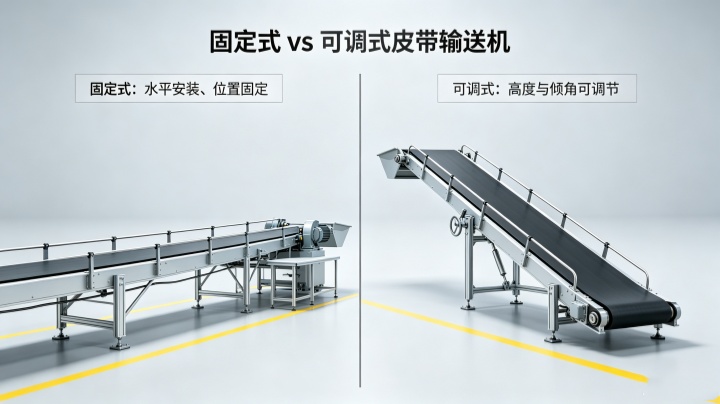
The fundamental distinction between these two systems lies in their adaptability.
Fixed conveyors are designed for one purpose, one location, and one configuration. They excel in high-throughput, stable-SKU hubs with long contract horizons where continuous high-rate sortation with low SKU variability is the norm. They are the workhorses of production lines that never change.
Adjustable belt conveyors, on the other hand, are engineered to adapt. Depending on the model, they can feature adjustable angles, heights, or even lengths. This is achieved through mechanisms like electric push rods, screw drives, or hydraulic systems that allow operators to modify the conveyor's configuration to suit different tasks or connect equipment at varying heights. As one technical description notes, traditional fixed conveyors cannot adjust to different equipment positions and heights, forcing users to purchase multiple units and increasing costs.
To determine which system saves you more in the long run, we need to look beyond the sticker price and examine several critical financial and operational factors.
Fixed Conveyor: Generally has a lower unit cost per meter. The design is simpler, and there are fewer moving mechanical parts for adjustment, making the initial purchase price more attractive.
Adjustable Conveyor: Has a slightly higher per-meter CAPEX due to the added engineering, motors, and control systems required for adjustability. For example, a model with an adjustable angle requires a base, support columns, motors, threaded rods, and more complex framing.
Verdict: Fixed conveyors win on initial purchase price. However, as a hydraulic or screw-adjustable system eliminates the need to purchase multiple different conveyors for different tasks, this extra upfront cost can be easily offset.
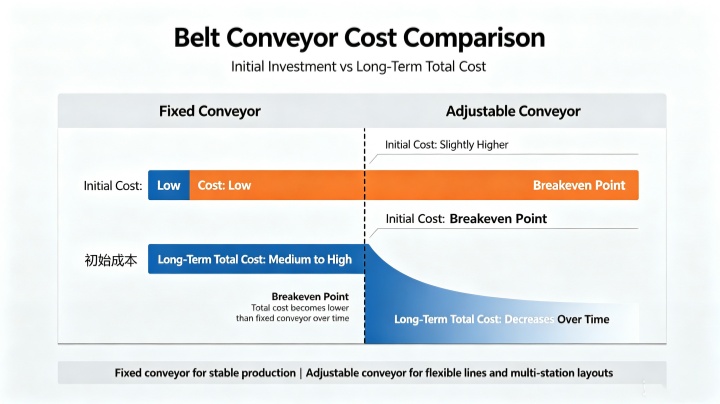
This is where the adjustable conveyor begins to fight back.
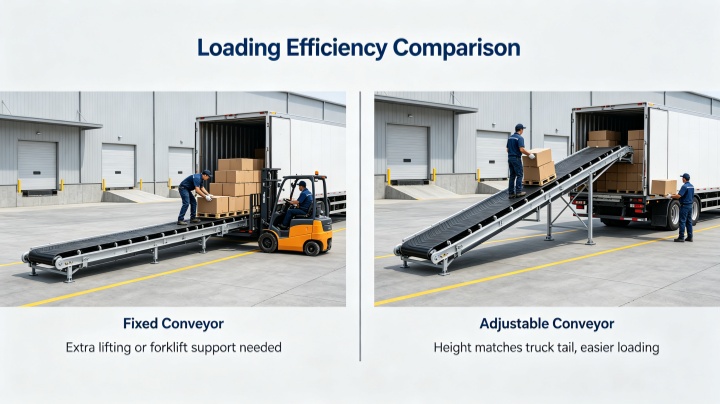
Fixed Conveyor: Lacks flexibility. If you need to load trucks of different heights or connect to different machinery, you may require a forklift or manual labor to bridge the gap. This adds labor hours and increases the risk of workplace injuries.
Adjustable Conveyor: Can be quickly repositioned and reconfigured. A mobile adjustable belt conveyor can extend directly into a truck trailer, significantly reducing manual travel and handling. For a regional sort center, using one telescopic conveyor can save 4 labor hours per day at an assumed labor cost of $17/hour, generating annual net savings of $17,680.
Verdict: Adjustable conveyors dramatically reduce labor costs by minimizing manual intervention and speeding up loading/unloading processes.
This is the single biggest advantage of adjustable systems and a major weakness of fixed ones.
Fixed Conveyor: Offers poor redeployability. Once installed, it is difficult and costly to move or modify. If your production line layout changes, the fixed conveyor becomes a stranded asset. A patent for a distance-adjustable conveyor specifically highlights that fixed-length conveyors limit production line transformation, making it difficult to adapt to different product models.
Adjustable Conveyor: Is designed for redeployment. Whether it's a wheeled mobile conveyor or one with a telescopic boom, these systems can be relocated and set up in different areas with minimal downtime. This allows businesses to adapt to changing seasonal demands or multi-tenant warehouse configurations without major capital reinvestment.
Fixed Conveyor: Maintenance is predictable. Standardized parts are usually easy to source. However, because they are static, localized wear on bearings and rollers can become an issue if they are operating under constant, heavy loads.
Adjustable Conveyor: Has more components (hydraulic pumps, motors, wiring for controls), which means potentially more points of failure. However, many adjustable systems use modular designs. For example, a telescopic conveyor might have a maintenance cost of approximately 5–12% of its capital cost annually.
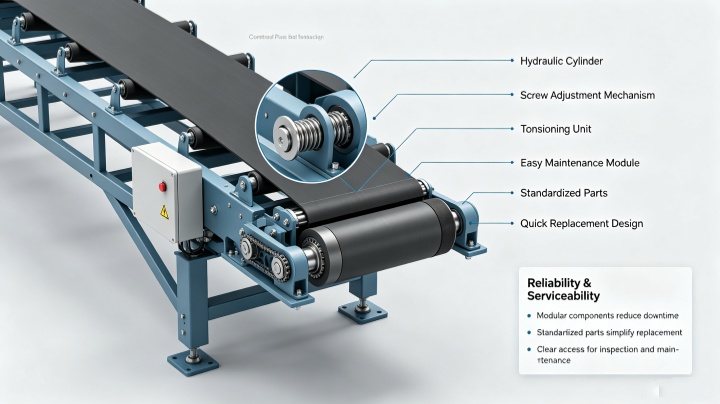
Unlike fixed systems, an adjustable belt conveyor offers reconfigurability. Key adjustment mechanisms include:
This flexibility allows a single adjustable conveyor system to serve multiple workstations or loading docks, a feat impossible for a fixed conveyor .
The answer depends entirely on your operational environment.
Choose a Fixed Conveyor if:
Choose an Adjustable Conveyor if:
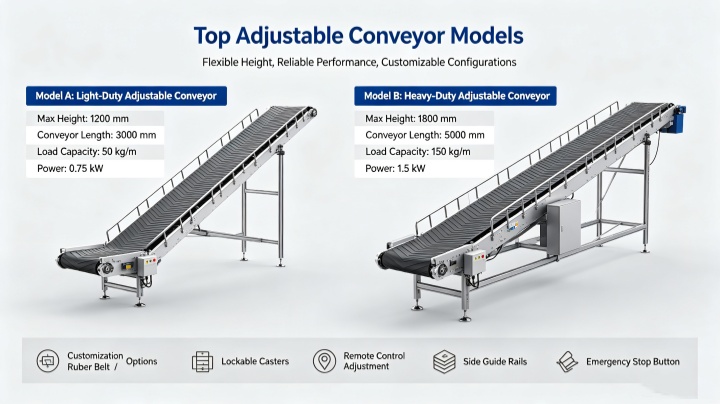
While the fixed conveyor wins on simplicity and upfront cost, the adjustable belt conveyor saves you more in the long run—provided your operation values flexibility and adaptability.
The long-term savings come from three main areas:
The primary advantage is flexibility. An adjustable belt conveyor can be reconfigured to handle different tasks, connect to equipment at varying heights, or be relocated, whereas a fixed conveyor is a permanent installation for a single purpose .
An adjustable conveyor saves more money in the long run (typically 3-7 years) by significantly reducing labor costs and increasing asset utilization. It can replace multiple fixed conveyors and adapt to future layout changes, avoiding costly retrofits .
For operations with stable demand and a facility life exceeding the system depreciation horizon, a fixed conveyor minimizes the cost per unit sorted. But for the vast majority of modern warehouses, distribution centers, and multi-product manufacturing lines, the reconfigurability of an adjustable belt conveyor makes it the smarter financial decision over a 3–7 year window.
Ultimately, while the fixed conveyor wins on simplicity, the adjustable belt conveyor offers superior long-term value for dynamic operations. The savings from labor reduction, asset utilization, and future-proofing make it the smarter investment for most modern facilities.
Ready to find the perfect conveyor solution for your business? [Contact us today] to discuss your specific application and get a customized quote that includes long-term cost analysis.
CONTACT
WhatsApp:+86 18339211009
Email:sale@xxdahan.com
Add:China, Henan Province, Xinxiang City.Yanjin county forest park gate to the west 1000 meters north road