E-mail: sale@xxdahan.com
Follow Us 


There's a number most conveyor buyers don't think about until it's too late: 20 degrees.
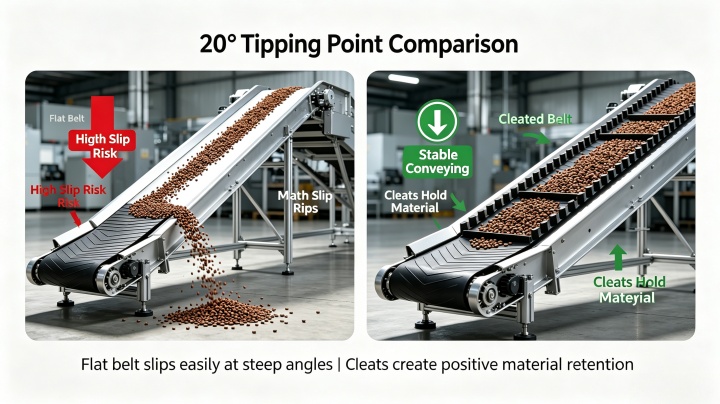
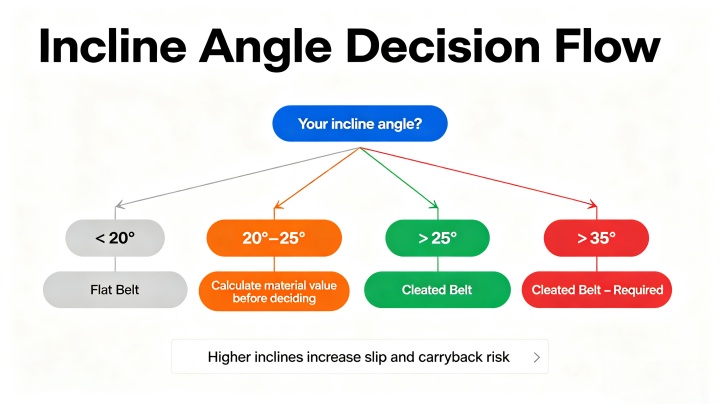
Below 20°, a standard flat belt conveyor works perfectly fine. Above it, you're not just moving material — you're losing it. And the steeper the incline, the more you lose.
The data shows that over 70% of facilities operating flat belt conveyors on inclines above 25° switch to cleated belts within two years of installation. Not because the flat belt broke down, but because the cumulative material loss, cleanup labor, and downtime became too expensive to ignore.
So here's the real question: Which conveyor actually saves you money on inclines?
This article breaks down the cost comparison across three critical dimensions — performance, total cost of ownership, and long-term reliability — so you can make a data-driven decision for your operation.
Before we compare costs, let's clarify what we're comparing.
A flat belt conveyor uses a smooth, continuous belt surface. It relies entirely on friction between the belt and the material to move product forward. On horizontal or low-angle applications (under 20°), friction is sufficient.
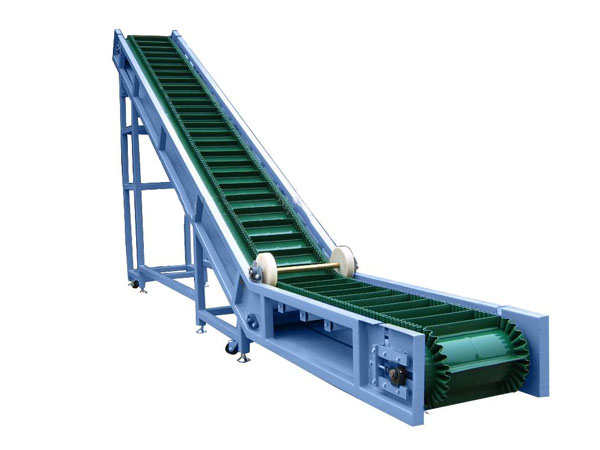
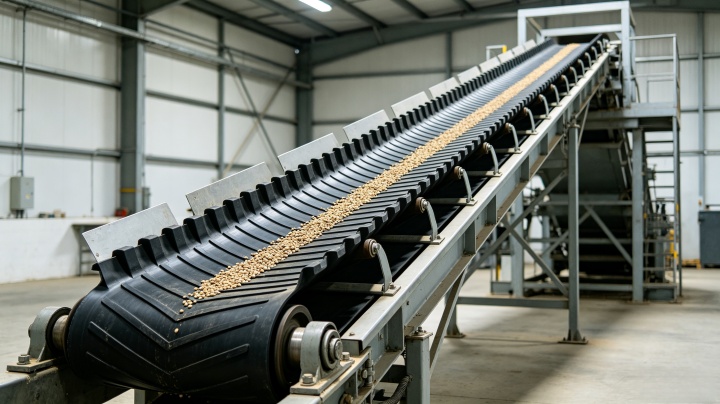
A cleated belt conveyor uses raised barriers — called cleats — that are vulcanized or mechanically attached to the belt surface. These cleats physically trap material between each barrier, preventing it from sliding backward regardless of the incline angle. This mechanical advantage is the key difference.
The mechanical reality: A flat belt depends on friction. A cleated belt depends on physics. Friction fails as angle increases. Physics doesn't.
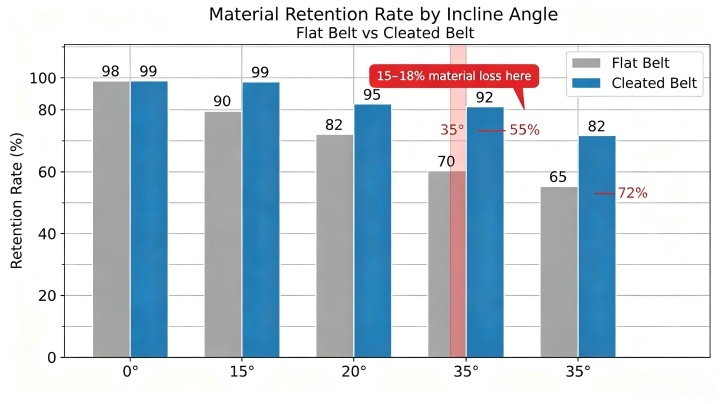
Here's where the numbers get real. Independent tests show the following material retention rates across different incline angles:
| Incline Angle | Flat Belt Performance | Cleated Belt Performance |
| 0° – 15° | 98-100% material retention | 100% retention (over-engineered) |
| 16° – 20° | 95-98% retention | 100% retention |
| 21° – 25° | 85-92% retention — material begins sliding | 100% retention |
| 26° – 30° | 70-82% retention — significant spillage | 99-100% retention |
| 31° – 35° | 50-65% retention — frequent jams and cleanup | 98-100% retention |
| 35° – 45° | Not operationally viable | 95-98% retention (with proper cleat design) |
What this means in real terms: At 25° incline, a flat belt conveyor running at 100 tons per hour is actually delivering only 85-92 tons to your destination. The rest? It's sliding back, building up at the tail section, and requiring manual cleanup. On a cleated belt, that same 100 tons per hour arrives — all of it.
The throughput gap widens with angle. At 30°, you're losing nearly one-fifth of your throughput on a flat belt. That's not a performance issue — that's a fundamental design mismatch.
Most buyers compare only the upfront purchase price. This is a mistake. The real cost difference shows up in operations, not procurement.
Let's look at a typical medium-capacity incline conveyor (30° incline, 100 tons/hour, 8-hour operation day). All figures are illustrative based on industry averages — replace with your actual site data for precise calculation.
| Cost Item | Flat Belt Conveyor | Cleated Belt Conveyor |
| Belt purchase cost | $3,000 – $4,500 | $4,500 – $7,000 |
| Additional drive power required | None — standard motor | +15-20% motor size for cleat resistance |
| Installation cost | Standard | Standard (+ minimal) |
| Total initial investment | $8,000 – $12,000 | $11,000 – $17,000 |
Initial difference: Cleated belt costs approximately 30-50% more upfront.
| Cost Category | Flat Belt (at 30° Incline) | Cleated Belt (at 30° Incline) |
| Material loss (spillage) | 15-18% of throughput = ~13,000 tons/year lost at 100t/h × 8hr × 300 days | <1% loss = under 800 tons/year |
| Value of lost material | Varies by material. At $30/ton = $390,000/year | At $30/ton = under $24,000/year |
| Manual cleanup labor | 3-4 hours/day = ~900 hours/year @ $25/hr = $22,500/year | <0.5 hours/day = ~100 hours/year = $2,500/year |
| Spillage damage to idlers/rollers | Belt edge damage, material buildup on rollers — $1,500-3,000/year in extra maintenance | Minimal — clean operation — $500/year |
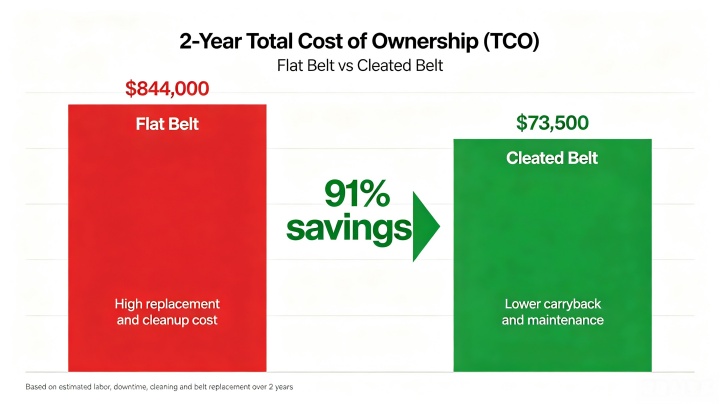
| Total annual operating cost | ~$415,000+ | ~$27,000 |
| Cost Component | Flat Belt | Cleated Belt |
| Initial investment | $10,000 | $14,000 |
| Year 1 operating cost | $415,000 | $27,000 |
| Year 2 operating cost | $415,000 (assuming unchanged conditions) | $27,000 |
| Belt replacement (2 years) | $4,000 (flat belt wears faster on incline) | $5,500 |
| 2-Year Total | ~$844,000 | ~$73,500 |
The cleated belt costs 40% more upfront. Over two years, it costs 91% less to run.
This is the math that matters. The material you don't lose pays for the cleated belt — many times over, in most cases within the first few months.
Beyond the direct dollars, several operational factors shift when you compare these two systems:
Flat belt: To reduce the incline angle to 20° or below, you need more horizontal run. A 30° incline over a 10-meter vertical rise requires 17.3 meters of horizontal length. At 20°, you need 27.5 meters — 60% more floor space.
Cleated belt: Maintains 30-45° incline, using significantly less floor space. For facilities where square footage is constrained (or expensive), this is a major capital saving that doesn't appear on the conveyor price tag.
Flat belt on incline: Roller lagging wears unevenly. Belt tracking issues increase due to lateral forces. Splicing requires more frequent inspection because the belt stretches unevenly under load.
Cleated belt: Even wear distribution. Better tracking due to consistent loading. Longer intervals between maintenance shutdowns.
Flat belt: Spilled material on the floor creates slip hazards. Workers must manually shovel material back onto the belt — repetitive strain and injury risk. Stalled belts due to material buildup require lockout/tagout procedures, increasing downtime.
Cleated belt: Clean floors. Minimal manual intervention. Reduced injury exposure.
| Criteria | Why |
| Incline is under 20° | Friction is sufficient — cleated is over-engineered |
| Material is free-flowing and non-abrasive | Spillage risk is minimal |
| Budget is severely constrained upfront | Lower initial cost, though you'll pay over time |
| Conveyor is short-term/temporary | Not worth investing in cleated for short projects |
| Criteria | Why |
| Incline is over 20° | Flat belt loses efficiency rapidly above this threshold |
| Material is valuable, dusty, or hazardous | Spillage cost is high — physically or financially |
| Floor space is limited or expensive | Steeper incline = shorter conveyor = less space |
| Operation is permanent or long-term | Lower TCO over >1 year |
| Cleanliness is critical | Food, pharmaceutical, or high-purity applications |
| Labor costs are high in your region | Payback comes faster where cleanup labor is expensive |
Manufacturers will quote you belt prices by the meter. Flat belts are cheaper per meter. But when you multiply by your annual throughput loss, that "cheaper" belt becomes the expensive choice within weeks.
Your conveyor may be "designed for" 20°, but site conditions change. Wet material, vibration, belt stretch, and loading variation all effectively increase spillage risk. Build in margin — if your site has any moisture or variability, add 3-5° to your design angle. If that lands above 22°, you should be on cleated.
Not all cleated belts are equal — cleat height, spacing, material, and attachment method all affect performance. For heavy materials, choose vulcanized cleats. For frequent belt changes, bolt-on cleats may be better. Always match cleat design to your material's flow properties. A mismatched cleated belt performs worse than a flat belt.
If the number exceeds the price difference between a flat and cleated belt (typically $3,000-$5,000), the cleated belt will pay for itself in less than two months. And over 2 years, it will save you over $750,000.
That's not a decision. That's arithmetic.
A: Yes — as long as the pulleys and frame support the cleat height. You'll need to replace the belt and possibly upgrade the drive motor. This is often more cost-effective than buying a new conveyor.
A: Up to 45° with standard cleats. With specialized designs (sidewalls + cleats), up to 60° or vertical.
A: Properly installed cleats do not affect tracking. Poorly vulcanized cleats can create tension variations that cause tracking issues. Always use a reputable manufacturer with quality control on vulcanization.
A: 3-5 years in typical industrial applications. Heavy abrasive materials or extreme temperatures reduce this — consult with your supplier for specific material recommendations.
A: Not recommended. Cleats are designed for one-direction operation. Reversing causes material to jam under the cleats and damages the belt structure.
Every incline application has unique throughput and layout requirements. Send us your material specs, conveying angle, and throughput requirements, and our senior engineers will calculate your custom TCO and provide a tailored equipment proposal within 24 hours.
CONTACT
WhatsApp:+86 18339211009
Email:sale@xxdahan.com
Add:China, Henan Province, Xinxiang City.Yanjin county forest park gate to the west 1000 meters north road