Reversible Belt Conveyor
Wednesday August-12 2026 10:03:18
What is a Reversible Belt Conveyor?
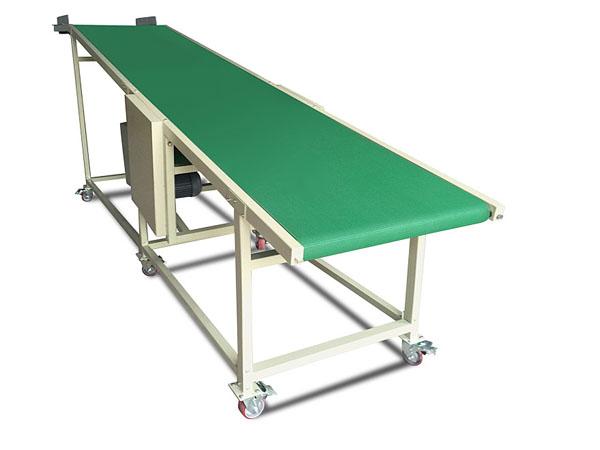
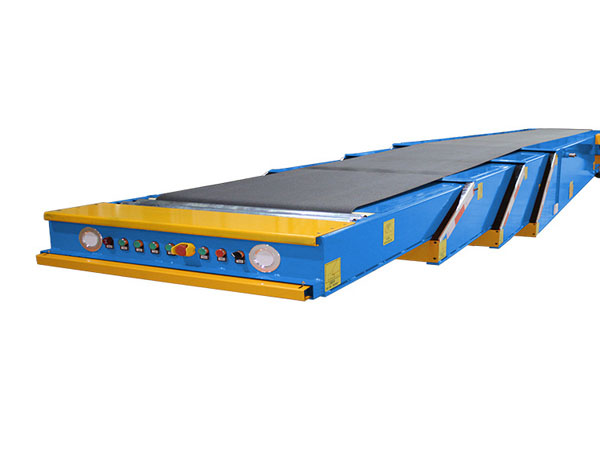
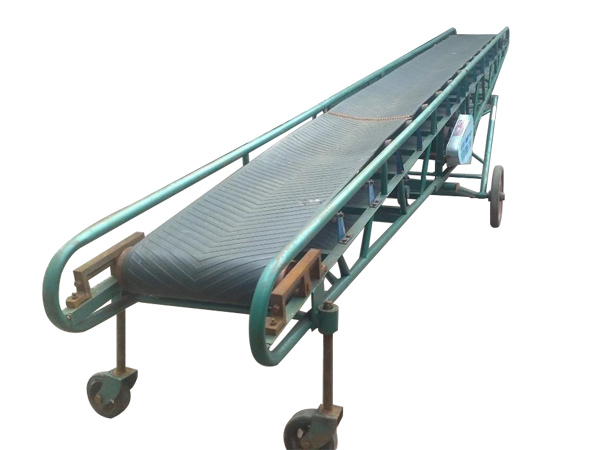
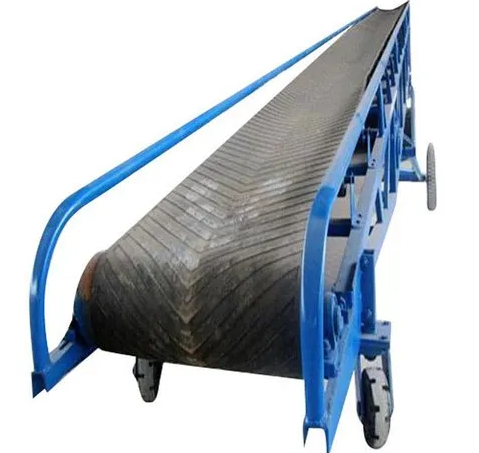
A reversible belt conveyor is an industrial material handling system powered by a reversible drive unit, designed to transport bulk materials in both forward and reverse directions. By simply switching the motor's rotational direction, a single conveyor can distribute materials to multiple discharge points, maximizing operational efficiency while reducing capital equipment investment.
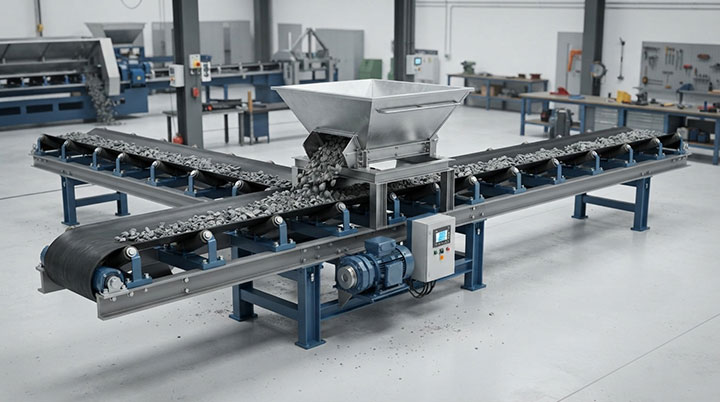
Core Mechanism: How Bi-Directional Transport Works
Unlike standard single-direction conveyors, a reversible belt conveyor utilizes a symmetric mechanical structure paired with a variable frequency drive (VFD). When the motor reverses, the belt travels in the opposite direction, instantly changing the discharge flow from one end of the conveyor to the other without manual repositioning.
When and Where to Use a Reversible Conveyor System
Ideal for multi-bin batching, shuttle loading, and continuous production lines where floor space is limited and material must be fed alternately into two or more adjacent silos or hoppers.
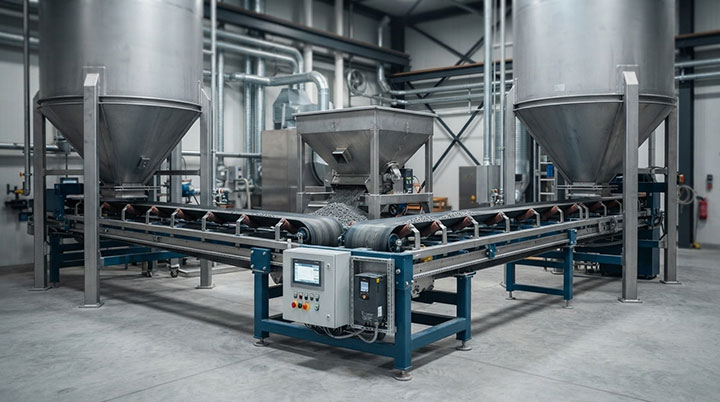
Technical Specifications and Custom Engineering Parameters
Standard and custom-engineered parameters designed to match heavy-duty industrial bulk material handling requirements:
|
Technical Parameter |
Standard Range |
Customization Options |
|
Belt Width (mm) |
500mm - 1400mm |
Tailored to throughput capacity |
|
Conveyor Length |
3m - 30m |
Modular design for extension |
|
Handling Capacity |
50 t/h - 500 t/h |
Matched with feeder feed rate |
|
Belt Speed |
0.8 m/s - 2.5 m/s |
VFD adjustable for smooth reversal |
|
Drive Motor Power |
4 kW - 30 kW |
Explosion-proof & heavy-duty options |
How to Calculate Capacity and Power Requirements
Conveyor capacity depends on belt width, speed, and material bulk density. Motor power is determined by total conveying length, lifting height, and friction resistance of symmetrical idlers during bi-directional runs. Contact our engineers for exact formula matching.
Core Structural Design of Dahan Reversible Belt Conveyors
Built with heavy-duty engineering standards to ensure seamless bi-directional switching and long-term reliability under continuous operation:
Reversible Drive and VFD Control Systems
Equipped with high-performance reversible gear motors and Variable Frequency Drive (VFD) integration. This allows smooth acceleration, deceleration, and instantaneous directional switching without mechanical shock or belt slipping.
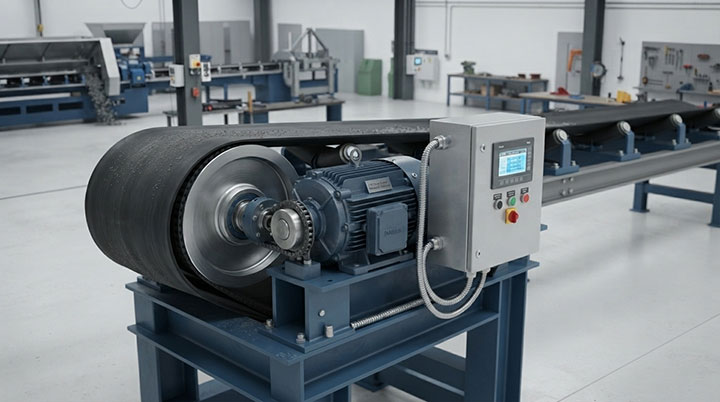
Symmetrical Idlers and Heavy-Duty Belt Tracking
Features symmetrical troughing idlers and precision-machined head/tail pulleys designed to support equal tension and tracking in both forward and reverse traveling directions, preventing edge wear and misalignment.
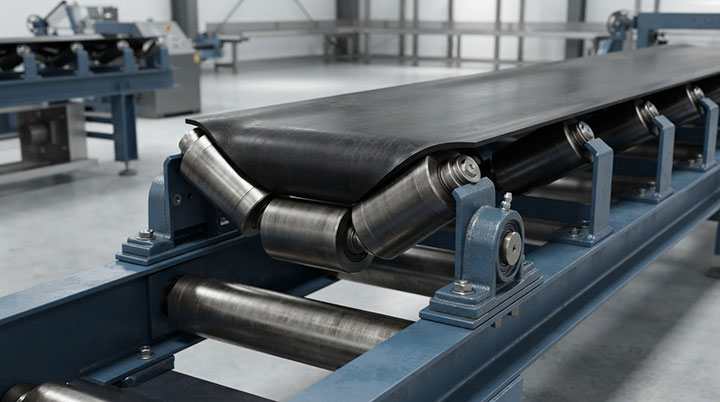
Dual-Direction Discharge and Feeding Mechanisms
Designed with center-feed chutes and multi-point discharge clearance. It allows clean material transfer into dual adjacent silos or reversible shuttle discharge systems without accumulation or spillages.
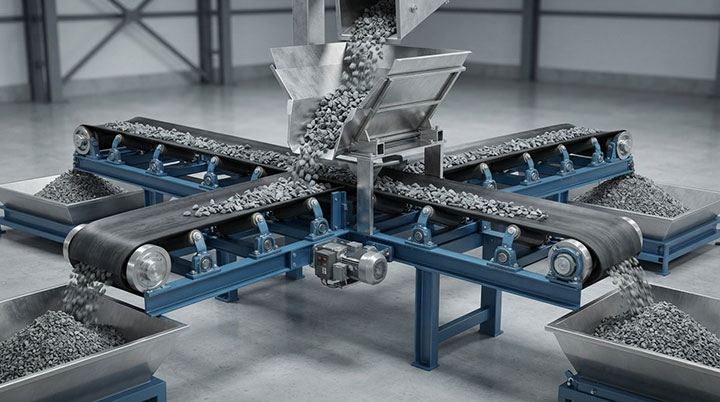
Why Choose a Bi-Directional Conveyor for Multi-Point Distribution?
Deploying a bi-directional reversible conveyor solves spatial constraints and significantly cuts operational costs compared to complex multi-conveyor arrangements:
Optimizing Plant Layout and Reducing Equipment Investment
Replacing two traditional single-direction conveyors with a single reversible unit cuts initial equipment investment by up to 40%. It eliminates the need for expensive tripper cars or additional transfer chutes, maximizing vertical space in compact processing plants.
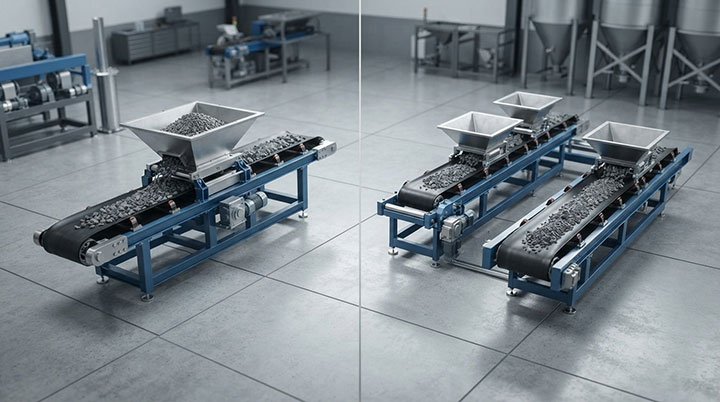
Minimizing Material Degradation and Spillage During Reversal
Engineered with symmetrical skirt boards and centered receiving hoppers, our conveyors ensure smooth material flow during directional changes. This prevents material blockage, minimizes dust generation, and reduces wear on belt surfaces.
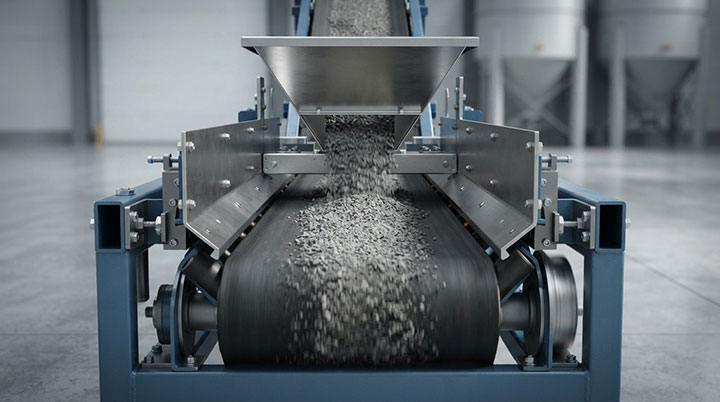
Typical Industrial Applications
Our reversible belt conveyors provide reliable and flexible multi-point material distribution across heavy-duty industries:
Multi-Compartment Batching Plants
Feeds raw aggregates alternately into adjacent weighing hoppers or storage bins with high positioning accuracy.
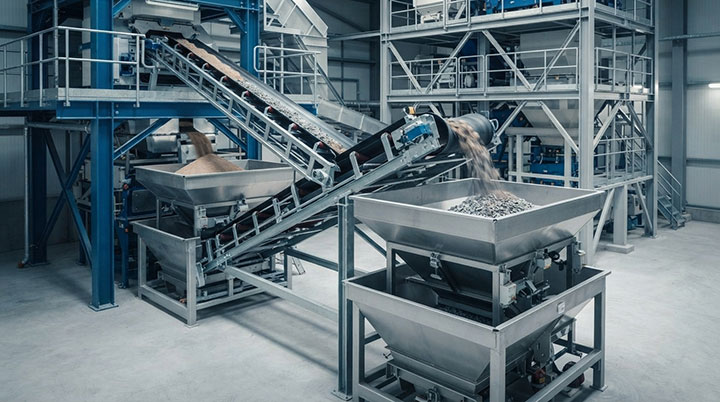
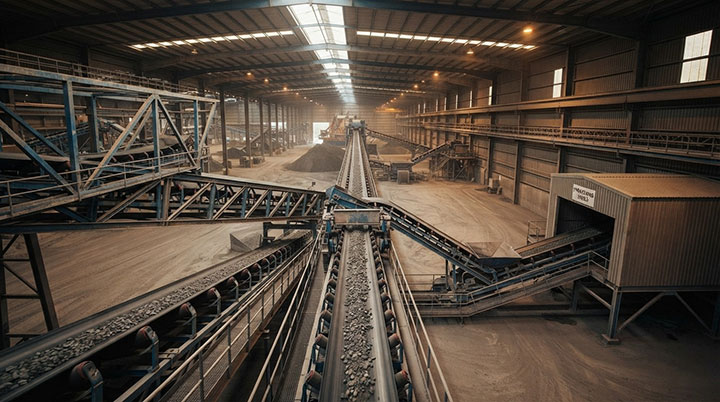
Bulk Material Terminals & Warehouses
Used in port and terminal yards to reverse material streams between stacking lines and processing sheds.
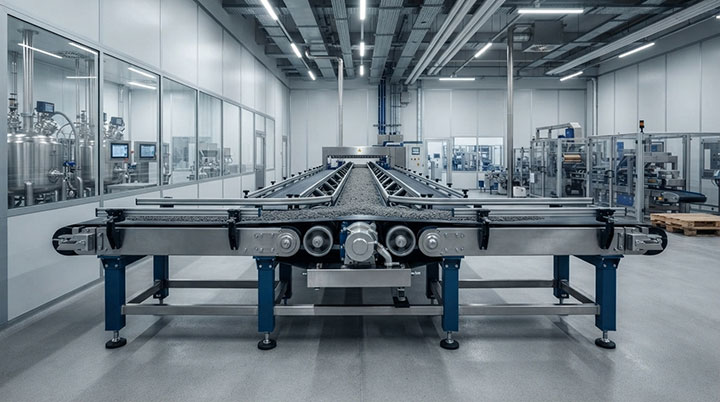
Inter-Process Manufacturing Lines
Transfers intermediate bulk products dynamically between different processing or packaging workshops.
Installation, Commissioning and Maintenance Best Practices
Ensuring long service life and reliable bi-directional performance relies on proper installation and routine upkeep:
Engineering Solutions: Preventing Belt Misalignment in Bi-Directional Runs
Because the belt travels in two directions, standard one-way training idlers are ineffective. We recommend installing symmetrical V-type return idlers, adjustable self-aligning idlers designed for dual-direction tracking, and ensuring head and tail pulleys are precisely parallel to prevent edge wear.
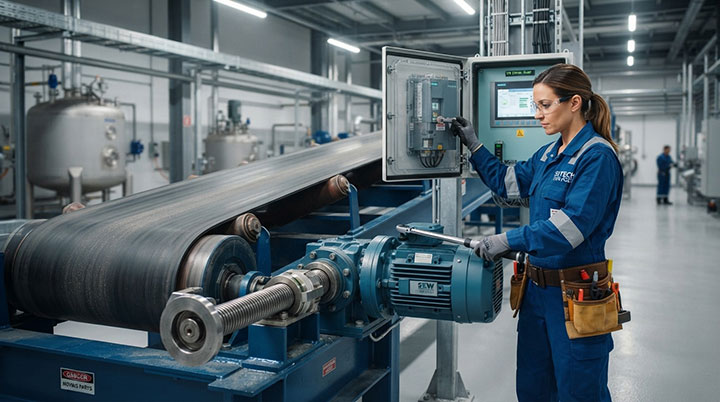
Routine Maintenance Checklist for Reversible Drives
-
VFD Acceleration Check: Regularly verify that the inverter ramp-up/ramp-down times are properly set to prevent mechanical shock loads during sudden switching.
-
Tension Adjustment: Inspect the screw or counterweight tensioner periodically to maintain optimal friction between the belt and the drive pulley in both directions.
-
Cleaning & Lubrication: Check dual-direction scraper blades and lubricate gear motor bearings according to operating hours.
Frequently Asked Questions (FAQs)
What is the maximum inclination angle for a reversible belt conveyor?
Reversible belt conveyors are typically designed for horizontal or gentle incline/decline operations (usually within 10° to 12° depending on material friction coefficient). Steep inclines can cause material sliding or rolling during directional reversal.
How does the motor handle frequent forward and reverse switching?
The drive system utilizes a heavy-duty reversible gear motor combined with a VFD (Variable Frequency Drive). The VFD controls smooth braking and acceleration ramps, preventing high inrush current shocks and protecting the mechanical transmission components.
Can an existing fixed belt conveyor be modified into a reversible one?
In most cases, simple modifications are insufficient because standard unidirectional idlers and non-symmetric drive setups will cause severe belt mistracking. Converting to a reversible system requires upgrading to symmetrical idlers, a reversible drive unit, and bi-directional vulcanized belt joints.
Ready to Optimize Your Material Handling System?
Contact our engineering team today for custom sizing, layout drawings, and a competitive quotation tailored to your plant requirements.