E-mail: sale@xxdahan.com
Follow Us 


Choosing the right telescopic conveyor for your loading dock is one of the most critical decisions you'll make for your warehouse efficiency. Get it wrong, and you face bottlenecks, damaged goods, and unnecessary labor costs. Get it right, and you unlock a new level of throughput and operational smoothness.
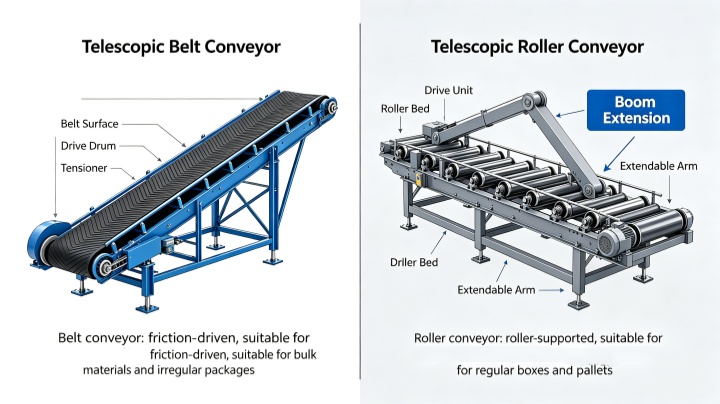
In this guide, we cut through the marketing noise to deliver a direct, side-by-side comparison of telescopic belt conveyors and telescopic roller conveyors. You'll learn exactly which system is the perfect match for your cargo type and operational workflow.
A telescopic belt conveyor is a type of material handling equipment designed to extend into a truck trailer to facilitate the rapid and ergonomic loading or unloading of cargo. It features a continuous, smooth rubber or PVC belt surface that provides friction-driven transport, making it ideal for moving irregularly shaped items, soft parcels, and high volumes of homogeneous cartons in warehouse and distribution center applications.
A telescopic belt conveyor operates through a motor that drives a continuous loop of belting material around a series of pulleys. The boom, typically consisting of 2 to 4 hydraulic or electrically powered segments, extends and retracts to provide seamless access to the trailer's interior. The uninterrupted flat belt surface grips items and moves them uniformly, ensuring a smooth and steady flow of cargo.
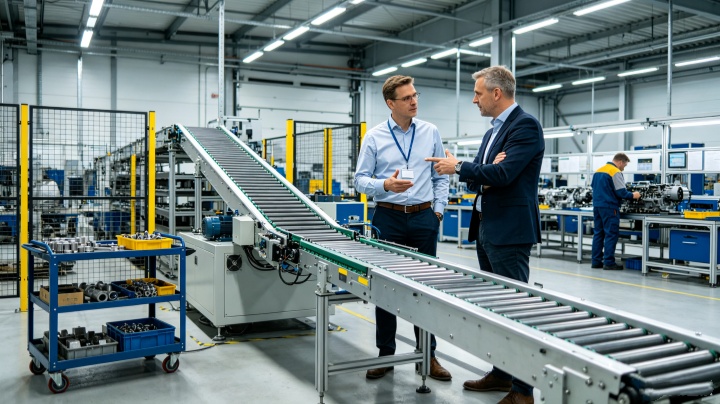
Instead of a solid belt, this system uses a series of rotating metal or plastic rollers mounted on an extendable frame. The cargo rolls across these rollers.
How it works:
Rollers can be powered (motor-driven for consistent movement) or gravity-fed (relying on a slight incline or manual pushing). When powered, each roller or zone of rollers can be controlled independently, allowing for zone accumulation—the ability to stop an item on the conveyor while the rollers behind continue moving.
Industry experts use a weighted evaluation framework to decide between conveyor architectures. We've adapted the key criteria—Throughput, Flexibility, Safety, and Total Cost of Ownership—to compare these two systems head-to-head.
| Feature / Criteria | Telescopic Belt Conveyor | Telescopic Roller Conveyor |
| Best For | Irregular shapes, bags, soft parcels, high-volume homogeneous cartons . | Flat-bottomed boxes, totes, heavy cases, and items requiring accumulation . |
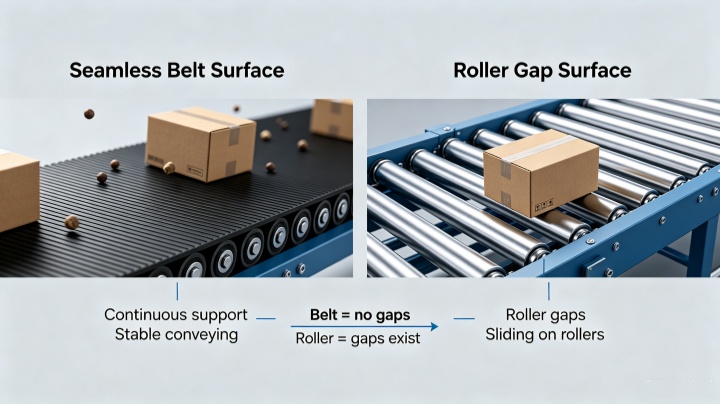
| Mechanism | Continuous belt provides smooth, friction-driven transport. No gaps between rollers, minimizing product bounce . | Series of rollers (powered or gravity). Allows for zone control and singulation (separating items) . |
| Cargo Compatibility | Excellent for: Polybags, soft packages, loose items, small parcels, and temperature-sensitive goods that can't tolerate impacts . Poor for: Heavy pallets or items with sharp edges that could cut the belt. | Excellent for: Rigid cartons, plastic totes, drums, and heavier freight. Poor for: Items with soft or irregular bottoms that could get stuck between rollers . |
| Operational Capability | High Throughput for a steady, continuous flow. Efficient for moving large quantities of similar-sized items . | Accumulation Control: Can "hold" items in a queue without stopping the upstream flow. Best for mixed-size flows requiring sorting or buffering . |
| Key Advantage | Ergonomics & Protection: Reduces physical strain, provides a gentle transport surface, and protects fragile goods from shock during loading/unloading . | Heavy Load Capacity: Handles heavier loads (often >70kg/m capacity) and provides superior durability for rough warehouse conditions . |
| Key Limitation | Less Flexible for Sorting: Harder to integrate zone-control logic for complex routing or singulation without additional automation . | Labor & Suitability: Gravity-fed versions require manual pushing; not suitable for irregular items that can jam between rollers . |
Let's look at real-world scenarios to help you visualize the decision.
Cargo: Polybags, soft packs, small cardboard boxes of varying sizes.
Recommendation: Choose Telescopic Belt Conveyor.
Why: E-commerce operations demand speed and gentle handling. A belt conveyor's continuous surface minimizes the risk of small or soft parcels slipping between rollers and causing jams. It provides smooth, uninterrupted flow directly from the sorting system into the trailer, accelerating load times for high-volume doors.
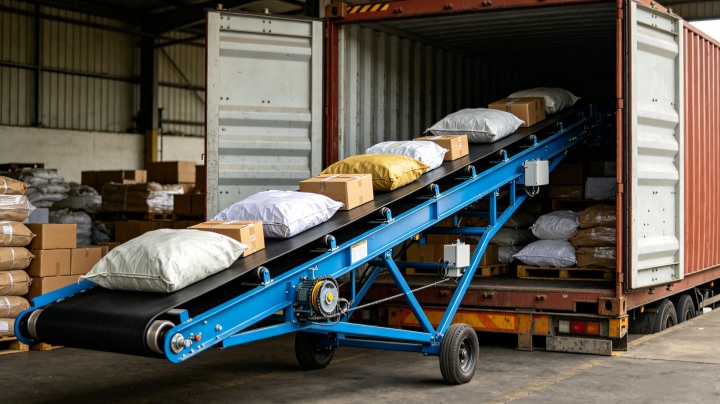
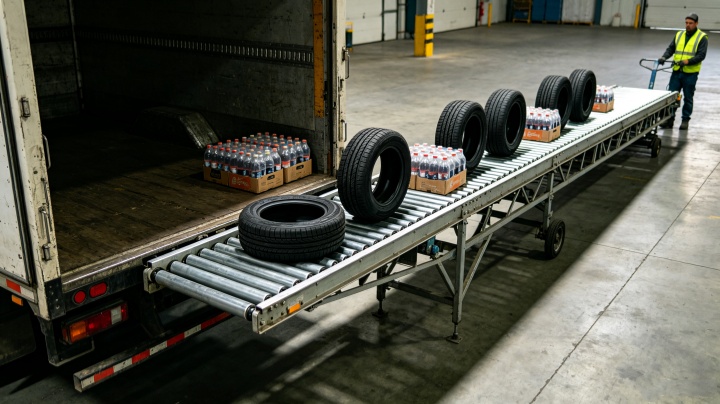
Cargo: Heavy cases of bottled drinks, stacked boxes, or tires with flat bottoms.
Recommendation: Choose Telescopic Roller Conveyor.
Why: Roller conveyors are built to withstand heavy-duty cycles without tearing or stretching. They excel when dealing with dense, heavy freight. If you need to stop the flow momentarily to reposition a pallet, the "zone accumulation" feature of powered roller systems allows you to pause items without stopping the entire conveyor.
Cargo: Mixed—Sometimes pallets, sometimes soft bags, sometimes small boxes.
Recommendation: Evaluate based on primary cargo. If 70% of your business involves heavy, rigid boxes, the roller system is a safer long-term investment. If you handle mostly consumer goods in flexible packaging, prioritize the belt system. Some 3PLs choose belt systems for their "universal" handling capability, accepting that they may need to handle heavy items more carefully.
Both systems are designed to solve the same problem: getting goods in and out of trailers faster and with less manual labor. However, they achieve this in fundamentally different ways.
Choose a Telescopic Belt Conveyor if:
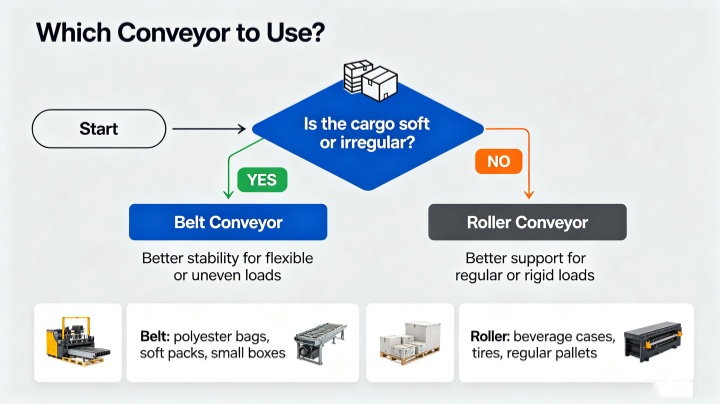
Choose a Telescopic Roller Conveyor if:
Need help making your final decision? Contact our team for a free consultation. We offer factory-direct pricing, full CE/ISO certifications, and on-time delivery guaranteed.
CONTACT
WhatsApp:+86 18339211009
Email:sale@xxdahan.com
Add:China, Henan Province, Xinxiang City.Yanjin county forest park gate to the west 1000 meters north road