E-mail: sale@xxdahan.com
Follow Us 


Choosing the right conveyor belt material directly affects belt service life, maintenance requirements, operating efficiency, and total conveying cost.
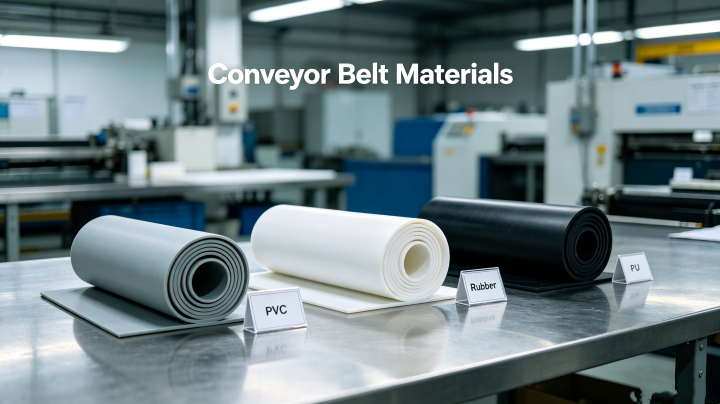
PVC, PU, and rubber are three common conveyor belt materials, but each performs differently under specific working conditions.
PVC conveyor belts are commonly used for general conveying, packaging, and logistics applications. PU conveyor belts are often selected when hygiene, cleanability, oil resistance, and wear resistance are important. Rubber conveyor belts are generally preferred for heavy‑duty applications requiring high abrasion resistance and impact protection.
However, there is no universal best conveyor belt material.
The correct choice depends on the conveyed product, load capacity, working environment, temperature, hygiene requirements, and conveyor design.
This guide explains How to Choose the Right Conveyor Belt Material by comparing PVC, PU, and rubber to help you select a suitable conveyor belt solution.
| Factor | PVC Conveyor Belt | PU Conveyor Belt | Rubber Conveyor Belt |
| Main applications | Packaging, logistics, general conveying | Food, pharmaceutical, clean applications | Mining, aggregate, heavy industry |
| Load capability | Light to medium | Light to medium | Medium to heavy |
| Abrasion resistance | Good | Excellent | Excellent |
| Impact resistance | Moderate | Good | Excellent |
| Oil resistance | Good | Excellent | Depends on compound |
| Cleaning performance | Good | Excellent | Depends on grade |
| Food applications | Available grades | Common choice | Special grades required |
| Main advantage | Cost‑effective and versatile | Hygiene and wear resistance | Strength and durability |
The comparison above is a general guideline. Actual performance depends on belt construction, reinforcement, thickness, surface design, and operating conditions. Material selection should always match the complete conveyor application rather than the material name alone.
PVC conveyor belts are widely used when flexibility, easy maintenance, and cost efficiency are important.
Typical applications include:
Packaging lines. Logistics systems. Warehousing. General manufacturing.
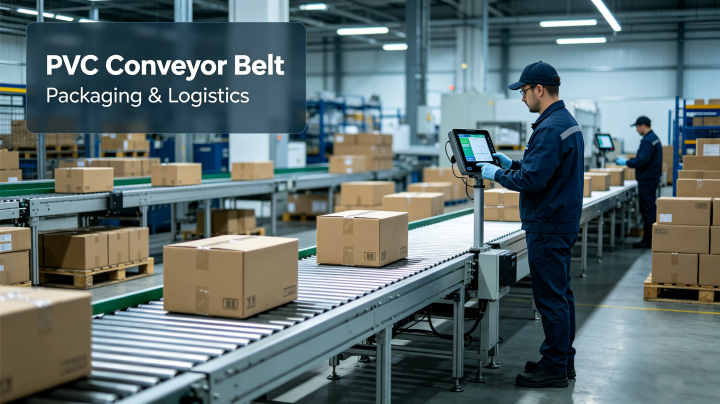
PVC is a practical choice for light and medium‑duty conveying because it provides a good balance between performance and cost.
However, PVC may not be suitable for:
Heavy impact loading. Sharp abrasive materials. Extremely demanding industrial conditions.
For these applications, a belt material with higher abrasion or impact resistance may provide better service life.
PU conveyor belts are commonly selected when cleanliness, oil resistance, wear resistance, and product protection are important.
Typical applications include:
Food processing. Pharmaceutical handling. Clean manufacturing environments. Precision conveying
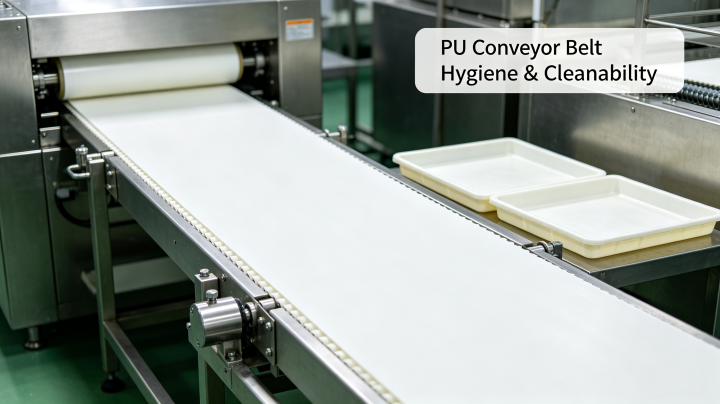
PU often performs better than standard PVC in applications involving oil, grease, frequent cleaning, or higher wear requirements.
However, PU is not automatically the best choice for every application.
For simple packaging or general conveying, PVC may provide a more economical solution. The correct choice depends on the actual operating conditions, not only the material category.
Rubber conveyor belts are widely used for demanding applications where strength, abrasion resistance, and impact resistance are required.
Typical applications include:
Mining. Quarrying. Aggregate handling. Bulk material conveying. Heavy industrial applications
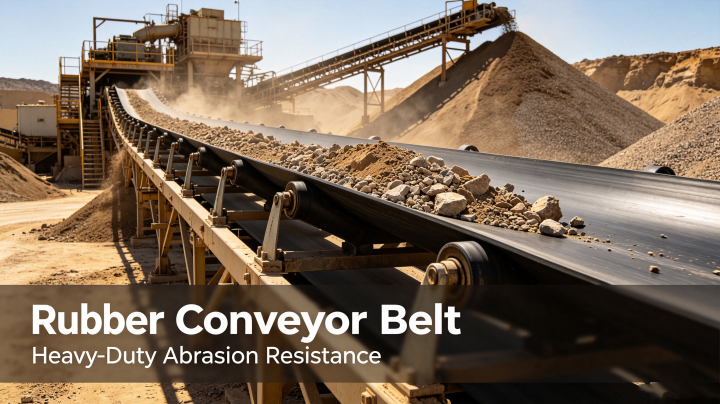
Rubber performs well when handling heavy, sharp, or abrasive materials.
However, rubber is not suitable for every environment.
For applications requiring strict hygiene, direct food contact, or frequent cleaning, specially selected PVC or PU grades may be more appropriate.
The correct selection process should begin with the actual operating conditions.
Consider the Conveyed Material
The transported product is one of the most important selection factors.
Evaluate: Material weight. Product size. Abrasiveness. Sharp edges. Oil content. Moisture
Examples:
Light packages usually work well with PVC. Oily or hygiene‑sensitive products often require PU. Heavy abrasive materials generally require rubber.
Check Load and Conveyor Capacity
The load determines the required belt strength and construction.
| Parameter | Why It Matters |
| Material weight | Determines belt strength |
| Belt width | Affects conveying capacity |
| Belt speed | Influences wear and performance |
| Loading impact | Determines impact resistance |
Using a light‑duty belt for heavy materials is one of the most common causes of premature failure.
Evaluate Working Environment
The operating environment can significantly affect belt performance.
Consider: Temperature. Oil exposure. Chemical contact. Moisture. Cleaning conditions. Outdoor exposure.
A belt suitable for one environment may fail quickly in another if the material compatibility is incorrect.
Consider Hygiene Requirements
For food processing, pharmaceutical, and clean applications, hygiene requirements must be considered.
Important factors include: Food contact requirements. Cleaning frequency. Chemical cleaning agents. Surface design.
PU and suitable PVC grades are commonly selected for hygiene‑sensitive applications.
Material Selection Priority
When choosing between PVC, PU, and rubber, follow this order:
Conveyed material Determine product weight, size, and characteristics.
Working environment Check temperature, chemicals, moisture, and cleaning conditions.
Required performance Identify abrasion resistance, impact resistance, hygiene, or oil resistance requirements.
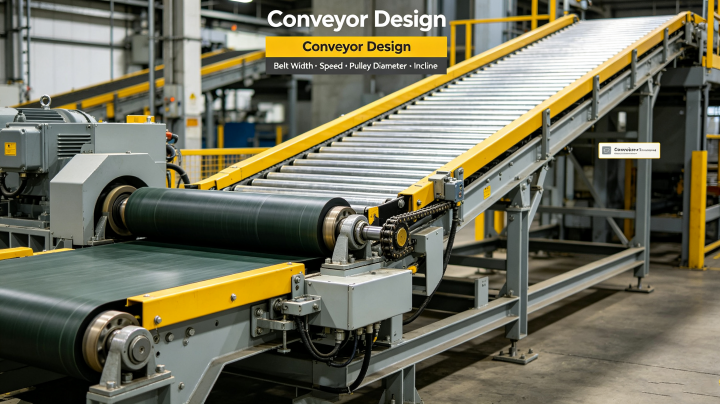
Conveyor design Consider belt width, speed, pulley diameter, and incline.
Total operating cost Compare purchase price with maintenance and replacement frequency.
The lowest initial cost does not always provide the lowest long‑term cost.
Material is only one part of the conveyor belt specification.
| Conveyor Factor | Importance |
| Belt width | Determines conveying capacity |
| Belt speed | Affects wear and operating performance |
| Pulley diameter | Influences belt flexibility and service life |
| Incline angle | Determines grip requirements |
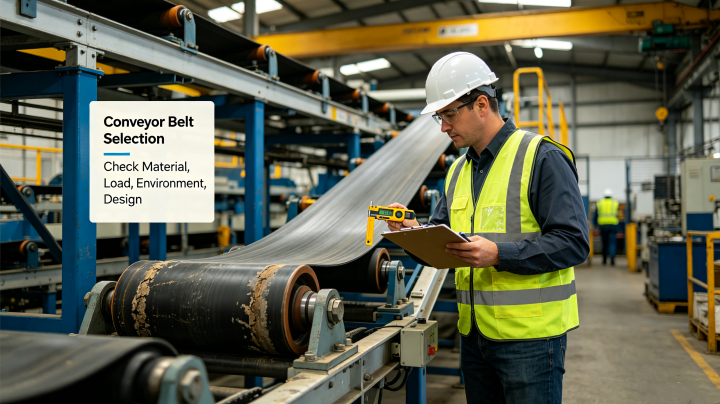
A suitable belt material can still fail if the conveyor design is not matched correctly.
Replacing a failed belt with the same material does not always solve the problem.
First identify the failure cause.
| Failure Symptom | Possible Cause |
| Excessive wear | Insufficient abrasion resistance |
| Cuts or tears | Insufficient impact resistance |
| Swelling | Chemical incompatibility |
| Cracking | Temperature or environment issue |
| Stretching | Incorrect reinforcement or tension |
Understanding the failure reason helps prevent repeated replacement with an unsuitable belt.
| Application | Recommended Material |
| Packaging | PVC |
| Logistics | PVC |
| General manufacturing | PVC |
| Food processing | PU or suitable PVC |
| Oily products | PU |
| Pharmaceutical applications | PU |
| Mining | Rubber |
| Quarrying | Rubber |
| Aggregate conveying | Rubber |
This guide provides a starting point. The final specification should always consider the complete operating environment.
Choosing Only by Price
A cheaper belt may increase maintenance costs if replacement frequency is high.
Replacing the Old Belt Without Finding the Failure Cause
The previous belt may not have matched the actual application.
Using Light‑Duty Belts for Heavy Materials
Heavy loads require stronger belt construction.
Ignoring Conveyor Design
Speed, tension, pulley size, and loading conditions also affect belt performance.
Providing complete application information helps determine the correct belt specification.
| Information | Purpose |
| Conveyed material | Select suitable belt material |
| Capacity | Determine required strength |
| Belt width and length | Confirm belt size |
| Speed | Match belt construction |
| Temperature | Check compatibility |
| Working environment | Evaluate resistance requirements |
The more complete the operating information, the more accurately the belt material and construction can be selected.
Not always. PU is usually preferred for hygiene, oil resistance, and higher wear requirements. PVC may be more economical for general conveying applications.
Generally, rubber is more suitable for heavy‑duty applications because of its abrasion and impact resistance.
PU and suitable PVC grades are commonly used for food‑related applications. The correct choice depends on cleaning requirements and operating conditions.
Rubber is generally preferred for abrasive bulk materials such as stone, aggregate, and mining products.
You should provide the conveyed material, capacity, belt size, speed, temperature, environment, and application requirements.
Choosing the right conveyor belt material requires more than comparing PVC, PU, and rubber.
PVC is a practical choice for general conveying, packaging, and logistics applications.
PU is suitable when hygiene, cleanability, oil resistance, and wear resistance are important.
Rubber is generally preferred for heavy‑duty applications involving abrasion, impact, and bulk material handling.
Dahan evaluates application requirements such as conveyed material, load, environment, and conveyor design to help determine a suitable conveyor belt solution.
Before requesting a quotation, providing complete operating information can help ensure the selected belt matches the actual working conditions
CONTACT
WhatsApp:+86 18339211009
Email:sale@xxdahan.com
Add:China, Henan Province, Xinxiang City.Yanjin county forest park gate to the west 1000 meters north road