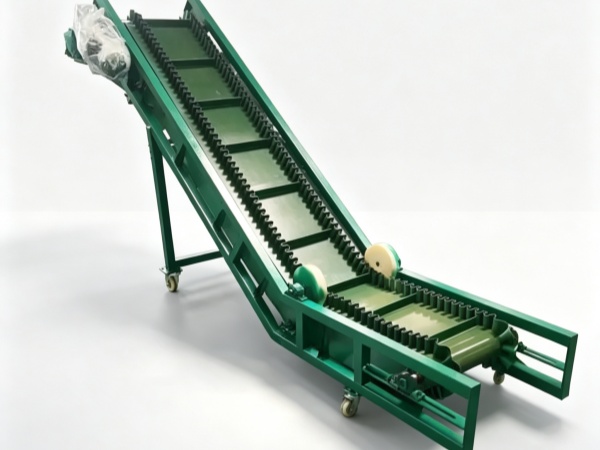
Corrugated Sidewall Belt Conveyor
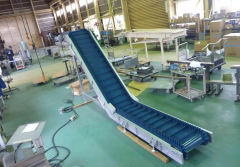
A Corrugated Sidewall Belt Conveyor is a specialized continuous material handling system designed to transport bulk materials at steep angles, ranging from conventional inclines up to a full vertical 90-degree lift.
- Conveying capacity: 70-278 cubic meters per hour
- Conveying length: 5-20 meters
- Conveyor belt speed: 0.8-1.6 m/s
- Conveying angle: 0° to 90°
What is a Corrugated Sidewall Belt Conveyor?
A Corrugated Sidewall Belt Conveyor is a specialized continuous material handling system designed to transport bulk materials at steep angles, ranging from conventional inclines up to a full vertical 90-degree lift. Unlike traditional flat conveyor belts that are limited to shallow angles (usually under 18 to 20 degrees) to prevent material rollback, a sidewall belt combines a high-strength base belt with corrugated sidewalls and transverse cleats. This forms an integrated "pocket" or "bucket" structure, allowing the system to elevate materials vertically in a minimal footprint.
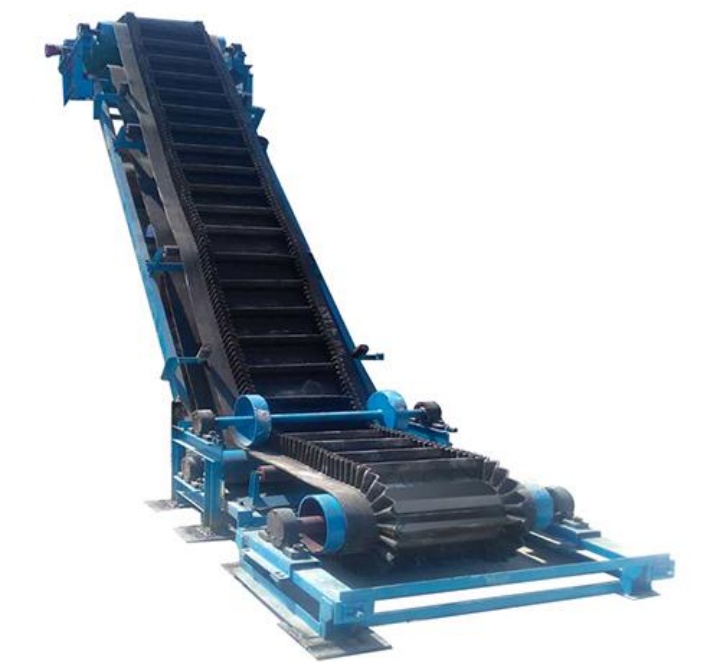
Core Structure of Corrugated Sidewall Belt Conveyor
The operational efficiency of a sidewall belt conveyor relies on a seamless integration of three primary structural components working together to trap and lift materials:
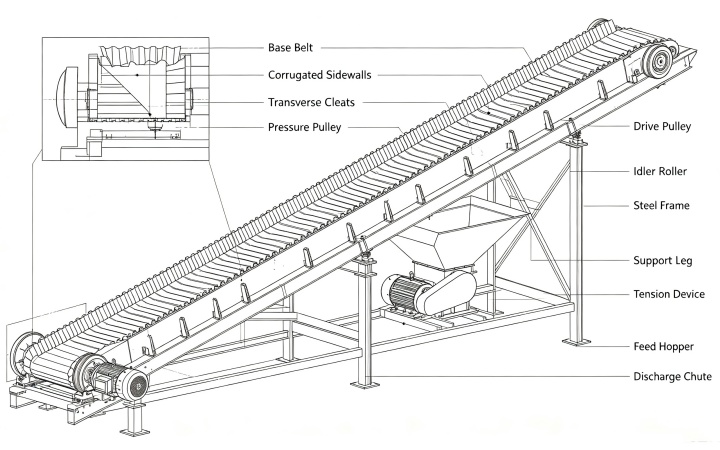
Base Belt (Cross-Rigid Base): Provides the longitudinal tensile strength required to pull the load while offering high transverse rigidity to prevent the belt from sagging or cupping under heavy loads and tension.
Corrugated Sidewalls: Vulcanized to the edges of the base belt, these flexible rubber walls expand and contract smoothly around pulleys while creating physical "walls" that prevent material from spilling over the sides.
Transverse Cleats (Cross Cleats): Positioned at regular intervals between the sidewalls, these rubber or polyurethane blocks act as mini-buckets that support the material load when the belt travels up steep or vertical sections.
Working Principle of Corrugated Sidewall Belt Conveyor
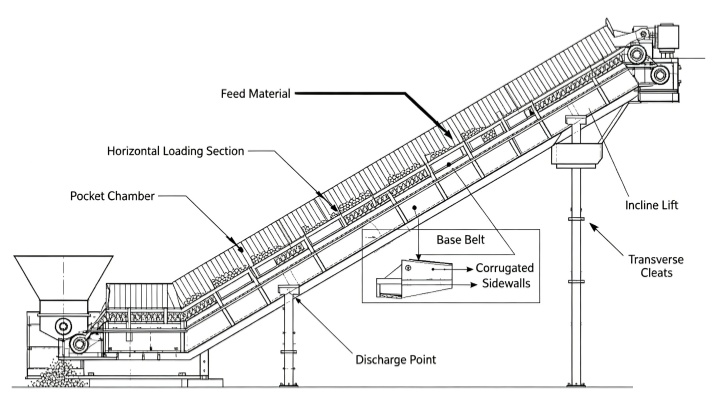
As the material is fed onto the horizontal loading section of the conveyor, it enters the pockets formed by the base belt, sidewalls, and cleats. The material is then securely trapped within these pockets as the belt transitions from a horizontal run into a steep incline or vertical lift, carrying the bulk material reliably to the discharge point at the top.
Core Strengths of Corrugated Sidewall Conveyors
Industrial facilities choose corrugated sidewall belt conveyors to solve complex material handling layout challenges. Key benefits include:
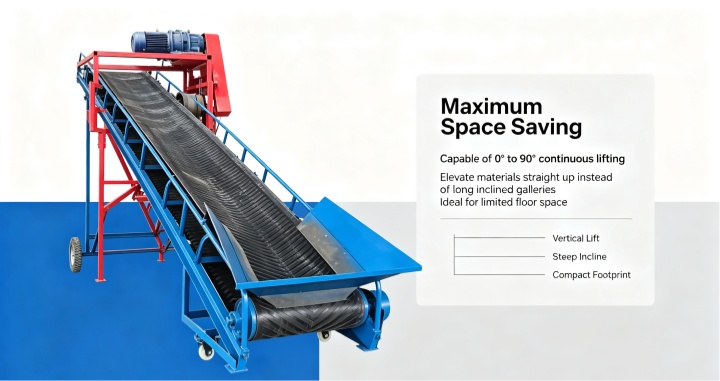
Maximum Space Saving
Capable of 0 to 90 degree continuous lifting, allowing plants to elevate materials straight up instead of utilizing lengthy, sprawling inclined conveyor galleries that require excessive floor space.
Zero Material Spillage
The combination of tall sidewalls and transverse cleats ensures that even fine powders, wet aggregates, or light granules will not slide backward or spill off the edges.
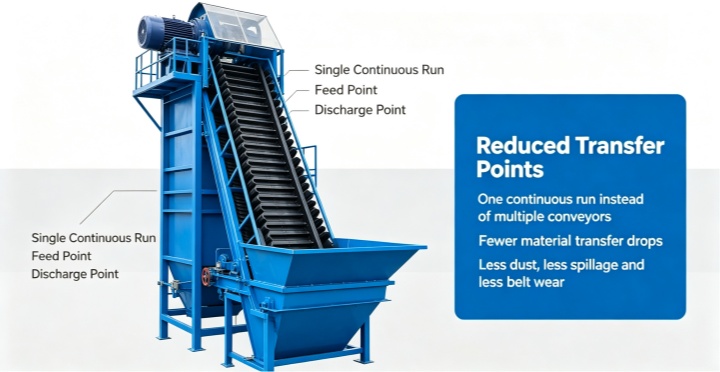
Reduced Transfer Points
Traditional high-lift setups often require multiple conveyors transferring material from one belt to the next. A sidewall conveyor achieves the same height in a single, continuous run, eliminating multiple transfer drops, reducing dust, and cutting wear and tear.
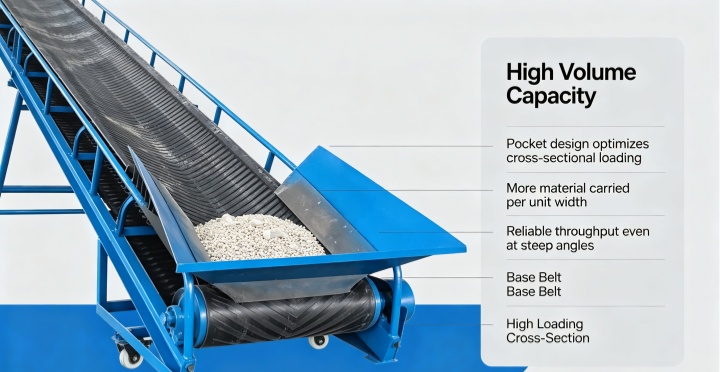
High Volume Capacity
The pocket design optimizes cross-sectional loading, delivering higher throughput capacities per unit width compared to standard troughed belts at steep angles.
Durability and Low Maintenance
High-frequency hot vulcanization bonds the sidewalls and cleats securely to the base belt, ensuring structural integrity under high-stress industrial environments.
Key Technical Specifications
| Belt Width (mm) | Sidewall Height Range (mm) | Cleat Height Range (mm) | Belt Speed Range (m/s) | Reference Capacity (m3/h) | Reference Power Range (kW) |
| 500 | 80 / 100 / 120 | 75 / 90 / 110 | 0.8~4.0 | approx. 84~104 | 1.5~30 |
| 650 | 100 / 120 / 160 | 90 / 110 / 150 | 0.8~4.0 | approx. 156~260 | 1.5~55 |
| 800 | 120 / 160 / 200 | 110 / 150 / 180 | 0.8~4.0 | approx. 186~500 | 2.2~90 |
| 1000 | 160 / 200 / 240 | 150 / 180 / 220 | 0.8~4.0 | approx. 428~800 | 4~110 |
| 1200 | 200 / 240 / 300 | 180 / 220 / 280 | 0.8~4.0 | approx. 535~1200 | 5.5~185 |
| 1400 | 240 / 300 / 400 | 220 / 280 / 360 | 0.8~4.0 | approx. 920~1600 | 5.5~185 |
Typical Industry Applications
Due to their versatility, corrugated sidewall belt conveyors are deployed across heavy industries handling loose bulk materials:
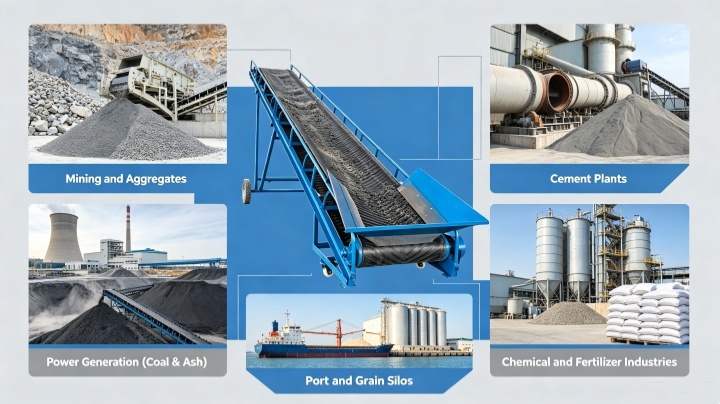
Mining and Aggregates: Transporting crushed rock, limestone, sand, and gravel out of deep pits or up processing plant silos.
Cement Plants: Handling raw meal, clinker, and coal feedstocks where high heat and abrasive dust resistance are required.
Power Generation (Coal & Ash): Moving coal from storage yards to boiler bunkers and managing bottom ash handling.
Chemical and Fertilizer Industries: Elevating granular chemicals, salt, phosphate, and potash smoothly without dust dispersion or corrosion issues.
Ports and Grain Silos: Vertical transfer of grain, oilseeds, and bulk commodities where gentle handling prevents product degradation.
Selection and Maintenance Guide
Selection Best Practices
Match Sidewall Height to Lump Size: Ensure that the sidewall and cleat height are at least two to three times larger than the maximum particle size of the material to prevent jamming or spill-over.
Calculate Tension Safely: For high vertical lifts, specify steel-cord base belts to handle the extreme dead-load tension without stretching or delaminating.
Environment Matching: Choose specialized rubber compounds (such as fire-retardant grades for underground coal mining or heat-resistant covers for foundry sand and clinker).
Maintenance Guidelines
Monitor Cleat and Sidewall Wear: Periodically inspect vulcanized joints for signs of peeling or cracking, especially at the transition zones where the belt flattens or bends over pulleys.
Optimize Return Idlers: Ensure that special resilient or profile return rollers are used to support the corrugated edges on the return run without crushing the sidewalls.
Control Tensioning: Maintain proper take-up tension to prevent belt slip at the drive pulley while avoiding excessive over-tensioning that accelerates mechanical wear on bearings and splices.
Elevate Your Material Handling Efficiency Today
Choosing the right material handling system is critical to minimizing downtime, maximizing facility space, and reducing long-term operational costs. A custom-engineered Corrugated Sidewall Belt Conveyor from Dahan Machinery provides a reliable, high-capacity, and maintenance-friendly solution tailored to your plant’s exact spatial and throughput demands.
Why Partner With Dahan Machinery?
Tailored Engineering Solutions: We design custom sidewall belt layouts, specialized rubber compounds (heat, oil, or flame-resistant), and exact sidewall-cleat configurations to match your specific bulk materials.
Proven Manufacturing Excellence: Built with high-strength EP/NN fabrics or steel-cord bases and superior hot-vulcanization bonding, ensuring an extended service life in demanding industrial environments.
End-to-End Technical Support: From initial capacity calculation and layout design to global installation guidance and dependable spare parts support.
Ready to Optimize Your Plant Operations?
Don't let space constraints or material spillage slow down your productivity. Contact the engineering team at Dahan Machinery today to discuss your project requirements, request a custom layout design, or get a competitive quote for your next sidewall conveyor system.